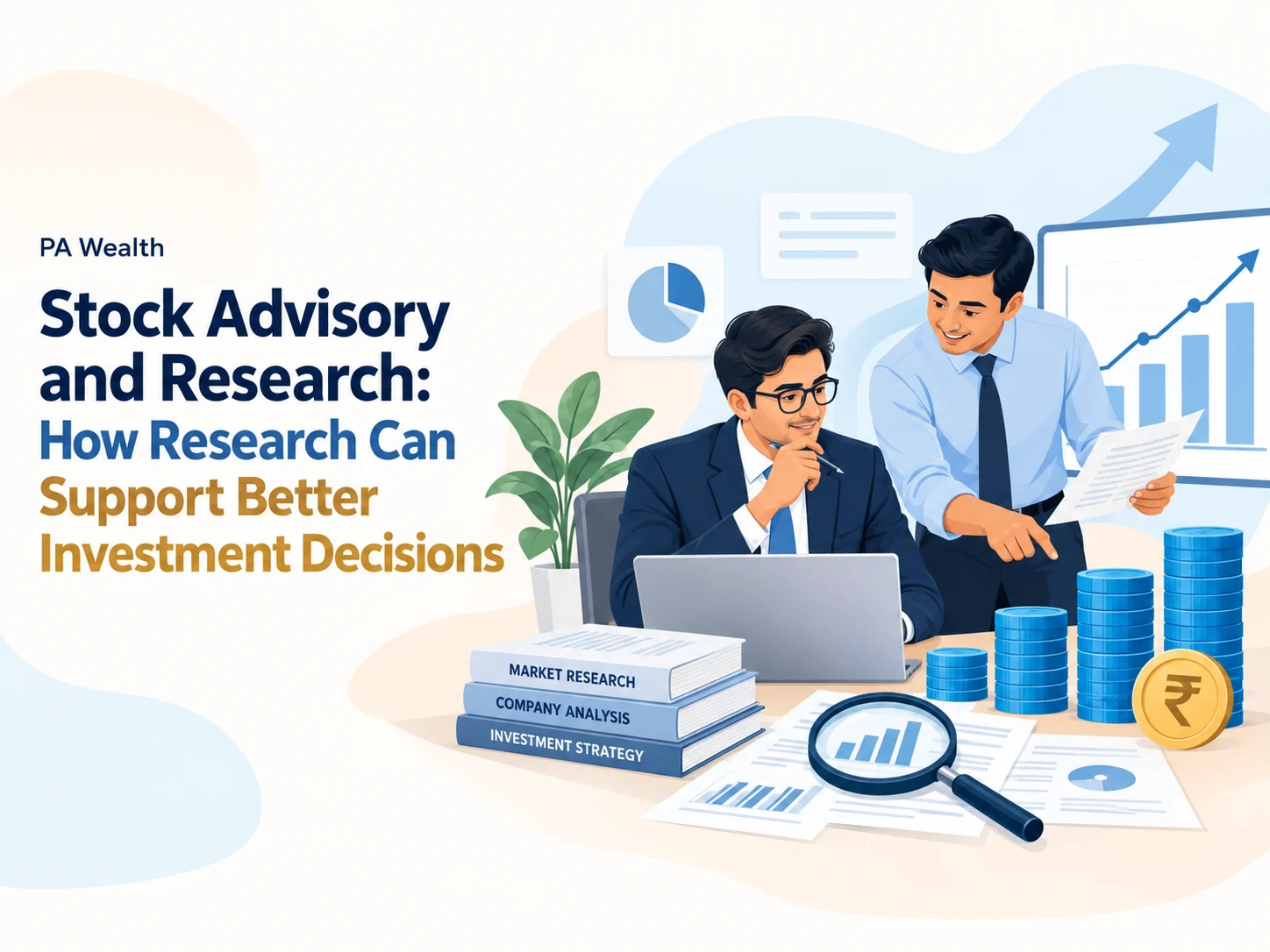

Investing in the stock market involves more than simply choosing a company whose share price is rising. A well-researched investment approach considers the business, financial performance, industry conditions, valuation, growth prospects and potential risks before making an investment decision.
This is where Stock Advisory / Research can play an important role. Stock research focuses on analysing businesses and market opportunities so that investors can make decisions based on information rather than short-term market movements or speculation.
For investors looking for a structured approach, understanding how stock research works can be useful before choosing a SEBI registered stock advisory service.
What Is Stock Advisory and Research?
Stock advisory and research involves studying listed companies, sectors and market conditions to identify potential investment opportunities.
A research-driven approach can include:
- Fundamental analysis of a company
- Revenue and profit growth analysis
- Balance sheet and cash-flow evaluation
- Industry and competitive analysis
- Valuation assessment
- Management quality assessment
- Risk evaluation
- Monitoring business and market developments
- Reviewing the investment thesis over time
The objective is not simply to identify stocks that are performing well today. Instead, research attempts to understand why a business may have the potential to create value over a particular investment horizon.
Why Research Matters in Stock Investing
Stock prices can move because of many factors, including earnings announcements, economic conditions, interest rates, sector trends, investor sentiment and broader market movements.
Without adequate research, investors may find it difficult to distinguish between a temporary price movement and a meaningful change in the underlying business.
A structured research process can help investors evaluate questions such as:
- Is the company’s revenue growing?
- Are profits sustainable?
- Does the business have competitive advantages?
- Is the company carrying excessive debt?
- What are the key industry risks?
- Is the current valuation reasonable?
- What could change the original investment thesis?
This process can make investment decisions more systematic and reduce dependence on market noise.
How Stock Research Can Identify Opportunities
A research team typically begins by studying businesses and sectors that may have attractive long-term characteristics. The analysis can involve several stages.
1. Business Analysis
The first step is understanding what the company does, how it generates revenue and what drives its growth.
A strong business model alone does not guarantee investment returns, but understanding the business provides an important foundation for further analysis.
2. Financial Analysis
Financial statements provide information about the company’s operating performance.
Researchers may examine:
- Revenue growth
- Profitability
- Operating margins
- Cash flows
- Debt levels
- Return ratios
- Capital allocation
Looking at these metrics over several years can provide more context than focusing on a single quarter.
3. Industry and Competitive Analysis
A company does not operate in isolation.
Its performance can be influenced by industry growth, competition, regulation, raw-material prices, technology and changing customer behaviour.
Therefore, stock research also considers the broader sector and competitive environment.
4. Valuation
Even a good company may not always be a good investment at every price.
Valuation analysis attempts to determine whether the market price adequately reflects the company’s future growth and business fundamentals.
5. Risk Assessment
Research also needs to identify what could go wrong.
Potential risks can include high valuations, debt, regulatory changes, competitive pressure, cyclical demand, execution challenges and changes in the broader economy.
A research-backed approach therefore considers both the potential opportunity and the potential downside.
The Importance of an Investment Thesis
A stock recommendation should ideally have a clear investment thesis.
An investment thesis explains why a company may create value and what factors could support the expected outcome.
For example, the thesis may be based on business expansion, improving profitability, industry growth, capacity expansion or other company-specific factors.
However, an investment thesis should not be treated as a guarantee.
Business conditions can change, and the actual outcome may differ significantly from the original expectation. This is why monitoring and reviewing the thesis is an important part of the research process.
Illustrative Past Recommendations
Historical examples can help explain how an investment thesis may perform over different time periods.
The following examples represent illustrative past recommendations from PA Wealth’s research material. They are historical examples and should not be interpreted as current recommendations.
| Company | Buy Price (₹) | Recommended Date | Sell Date | Holding Period | CMP at Exit (₹) | Absolute Gain | Approx. Return |
| BSE Ltd. | 123
(Split Adjusted) |
25-Aug-21 | 24-Nov-25 | 4 Years | 2,802 | 2,178% | ~22x |
| Solar Industries India Ltd. | 1,155 | 25-Jan-20 | 19-Nov-25 | 5 Years | 13,362 | 1,058% | ~12x |
| Polycab India Ltd. | 2,366 | 10-Nov-21 | 12-Dec-25 | 4 Years | 7,291 | 208% | ~3x |
| Kirloskar Oil Engines Ltd. | 396 | 28-Apr-23 | 05-Feb-26 | 2.8 Years | 1,195 | 202% | ~3x |
| Morepen Laboratories Ltd. | 53 | 12-Jun-25 | 12-Aug-25 | 62 Days | 106 | 100% | ~2x |
| Karnataka Bank Ltd. | 172 (approx.) | 23-Sep-25 | 10-Aug-26 | ~11 Months | 306 | 76% | ~1.8x |
What These Historical Results Tell Investors
Past results can provide useful context when evaluating a research process, but they should always be viewed carefully.
The examples above show different levels of absolute gains across different businesses and holding periods. However, historical performance does not establish what future investments will deliver.
A research-driven approach can help investors:
- Understand the business: Instead of focusing only on the stock price, research examines the underlying company.
- Create a structured investment thesis: The decision can be linked to specific business and financial factors.
- Evaluate risks: Understanding potential downside is as important as identifying potential upside.
- Maintain an investment horizon: Some investment ideas may require years to develop, while others may reach their intended outcome sooner.
- Review the thesis: If business fundamentals change, the original investment case may need to be reassessed.
Stock Advisory vs. Following Market Tips
There is a significant difference between research-based Stock Advisory and simply following market tips.
A market tip may focus primarily on a stock price, technical movement or short-term event. In contrast, research-backed stock advisory generally attempts to explain the reasoning behind an investment idea.
For investors, this distinction can be important.
Instead of asking only “Which stock should I buy?”, investors can also ask:
- What is the investment thesis?
- What research supports the idea?
- What are the major risks?
- What is the expected investment horizon?
- What could invalidate the thesis?
- How frequently is the recommendation reviewed?
These questions can help investors better understand the decision-making process behind a stock idea.
Choosing a SEBI Registered Stock Advisory
Investors considering professional stock advisory services should verify the credentials of the service provider.
A SEBI Registered Investment Advisor operates within the applicable regulatory framework and is required to follow prescribed requirements.
Before selecting an advisory service, investors can consider factors such as:
- SEBI registration details
- Transparency about the advisory process
- Research methodology
- Risk-management approach
- Disclosure practices
- Track record and historical information
- Suitability of the service for their investment objectives
Past performance should not be the only factor used to evaluate an advisory service.
Research, Patience and Discipline
Good investment research does not eliminate market risk.
Even carefully researched companies can experience periods of volatility or fail to perform according to expectations.
That is why research needs to be combined with patience and discipline.
An investor who understands the original thesis may be better positioned to evaluate whether a temporary price decline represents normal volatility or a fundamental deterioration in the investment case.
Similarly, strong price performance does not automatically mean that an investment should continue to be held. The original thesis, valuation and business outlook may need to be reassessed.
Understanding Investment Advisory Support
For investors who want a structured approach to understanding market opportunities, Investment Advisory can provide insights into research methodology, investment frameworks and risk considerations.
A professional advisory approach focuses on helping investors understand opportunities and risks rather than making decisions based only on short-term market movements.
Final Thoughts
Stock advisory and research can provide a structured framework for understanding investment opportunities.
Rather than relying entirely on short-term market movements, research examines businesses, financial performance, industry conditions, valuations and risks. A clear investment thesis can then help investors understand the reasoning behind an investment idea and the conditions that could affect its outcome.
The historical examples discussed above demonstrate how different investment ideas can perform over different periods. However, they are illustrative past results and not an indication of future returns.
Investors should conduct their own research, understand their risk tolerance and consider professional advice where appropriate before making investment decisions.
Explore PA Wealth Research Approach
Investors looking for a structured research-based approach can explore PA Wealth’s Stock Advisory services to understand how research and analysis can support investment decision-making.
Investor Awareness
Understanding investor rights and responsibilities is an important part of responsible investing. Investors can refer to the Investor Charter for additional information.
Disclaimer
This article is provided for educational and informational purposes only and should not be considered investment advice or a recommendation to buy or sell any security. Past performance does not guarantee future returns. Investors should conduct their own research and consult a qualified investment advisor before making investment decisions.
Investments in securities are subject to market risks. Read all related documents carefully before investing.