

Negen Undiscovered Value Fund: Inside a Catalyst-Driven Category III AIF
Most equity investors look for value in the same places: large, well-covered companies trading below their historical multiples. The Negen Undiscovered Value Fund (NUVF) looks somewhere less crowded. It hunts for special situations, pre-IPO companies and IPO anchor book allocations, where a specific event can unlock value that the broader market has not yet priced in.
This review looks at how the fund is built, what its factsheet for 30 September 2026 shows, what it costs, and the risks that come with a strategy like this. As a Category III AIF with a minimum investment of ₹1 crore, it is meant for investors who understand private pooled vehicles and can accept limited liquidity.
(A) About the Fund
NUVF is the first scheme launched by Negen Investment Trust, registered with SEBI as a Category III Alternative Investment Fund (SEBI Registration No. IN/AIF3/22-23/1254). The investment manager is Negen Capital Services Private Limited, which also manages two Category I angel funds and a SEBI registered Portfolio Management Service.
The fund aims to find undervalued investment opportunities with identifiable catalysts such as corporate actions, long-term industry trends or regulatory changes. It invests across special situations, pre-IPOs and anchor book investments, and also does regular value investing from time to time, buying good quality businesses below their perceived fair value. The benchmark is the BSE 500 TRI.
Definition – Category III AIF: A SEBI-regulated private pooled fund that uses diverse or complex trading strategies and, unlike Category I and II funds, may use leverage within SEBI limits. It is generally taxed at the fund level rather than passing income through to investors.
(B) Basic Details
| Particular | Detail |
|---|---|
| Scheme name | Negen Undiscovered Value Fund |
| Structure | Scheme of Negen Investment Trust, Category III AIF |
| Investment manager | Negen Capital Services Private Limited |
| Launch date | 25 May 2023 |
| First value date | 10 July 2023 |
| Inception NAV | ₹100.0000 |
| Current NAV (Class A1) | ₹231.2124 |
| Current AUM | ₹1,050.99 crore |
| Benchmark | BSE 500 TRI |
| Trustee | Axis Trustee Services Limited |
| Custodian | ICICI Bank Limited |
| Registrar and transfer agent | KFin Technologies Limited |
Source: NUVF factsheet, 30 September 2026.
(C) Portfolio Classification
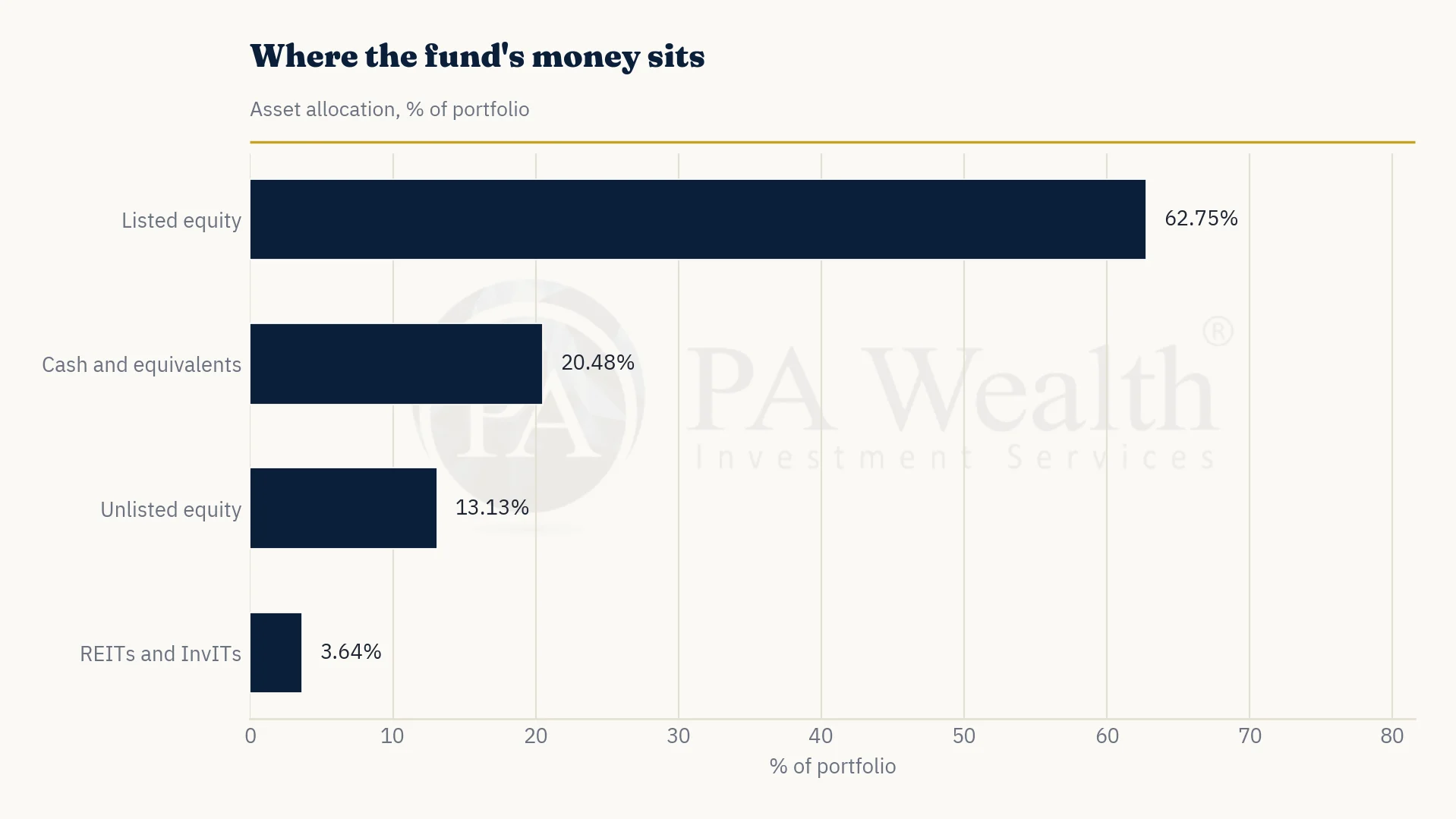
As per the factsheet, about 62.75% of the portfolio sits in listed equity and 13.13% in unlisted equity, with 3.64% in REITs and InvITs. The remaining 20.48% is held in cash and equivalents.
The cash level is worth noting. The factsheet’s cash line shows the fund held a large cash balance after launch, ran it down through 2024 and 2025 to low levels, and has built it up again in recent months. Cash gives the manager room to act when a new catalyst appears, but it also means a fifth of the portfolio is not working in equities at the moment.
The unlisted equity portion is a distinct feature of this fund. It reflects the pre-IPO strategy, where the fund invests in companies before they list, which can add return potential but also adds valuation and liquidity risk.
Top 5 holdings and sectors
| Top 5 stocks | Top 5 sectors |
|---|---|
| Digilogic Systems Limited | Industrial Products |
| Diffusion Engineers Limited | Breweries and Distilleries |
| Raymond Realty Limited | Aerospace and Defense |
| Dembla Valves Limited | Sugar |
| Gala Precision Engineering Limited | Specialty Chemicals |
The mix leans towards industrial and manufacturing businesses, several of them smaller companies. That is consistent with a strategy built around catalysts and under-researched names, and it also means the portfolio can behave very differently from a broad index.
(D) Fund Manager and Team
According to the fund’s website, the fund manager is Mr. Jigar Dinesh Shah. The founder of Negen Capital is Mr. Neil Bahal, who started investing at the age of 15 and has more than a decade of experience in the Indian capital market. He founded Negen PMS in April 2017 and Negen’s Category I AIF in April 2022.
The website states that Negen PMS maintained a 5 Star rating from PMSBazaar and CRISIL rankings over FY21, FY22 and FY23. The tenure of the fund manager on this specific scheme is not disclosed in the factsheet or on the website, so investors should ask for it directly.
(E) Investment Details
| Particular | Detail |
|---|---|
| Minimum investment | ₹1 crore |
| Investment management fee | 1.1% per annum of average daily NAV, plus applicable GST |
| Performance fee (profit sharing) | 11% per annum on pre-tax NAV with high watermark, plus applicable GST. No hurdle |
| Fund expenses | About 0.15% to 0.20% of contributed value |
| Lock-in | 12 months |
| Exit load, 12 to 24 months | 1% |
| Exit load, 24 to 36 months | 0.5% |
| Exit load, after 36 months | Nil |
| Redemption settlement | Up to 30 business days from the redemption date |
Source: NUVF factsheet, 30 September 2026.
Definition – High watermark: A performance fee is charged only on gains above the highest NAV previously reached, so investors do not pay twice for recovering earlier losses. In NUVF, the profit sharing period runs from 1 April to 31 March each year.
Settlement note: The factsheet explains that redemptions can take up to 30 business days because the fund may hold unlisted securities. If the manager cannot liquidate an investment, it may distribute the unliquidated holdings in-specie to investors, in line with AIF regulations and fund documents.
(F) Returns Generated
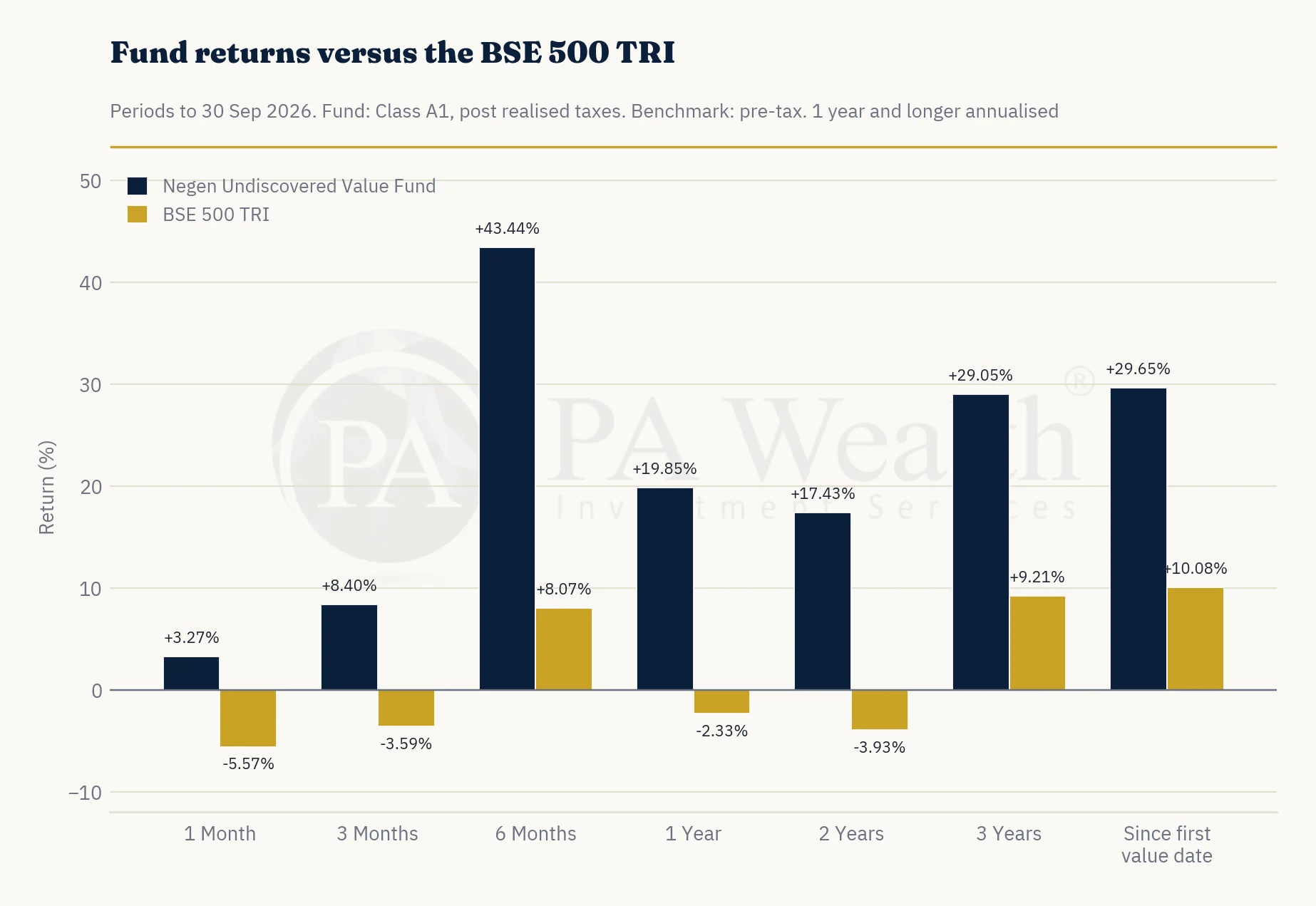
The table and charts below show the fund’s performance against the BSE 500 TRI to 30 September 2026. Fund performance is for Class A1 units, reported post realised taxes, while the benchmark is shown pre-tax. Returns over one year are annualised.
| Period | NUVF | BSE 500 TRI | Difference |
|---|---|---|---|
| 1 month | +3.27% | -5.57% | +8.84 pts |
| 3 months | +8.40% | -3.59% | +11.99 pts |
| 6 months | +43.44% | +8.07% | +35.37 pts |
| 1 year | +19.85% | -2.33% | +22.18 pts |
| 2 years | +17.43% | -3.93% | +21.36 pts |
| 3 years | +29.05% | +9.21% | +19.84 pts |
| Since first value date (CAGR) | +29.65% | +10.08% | +19.57 pts |
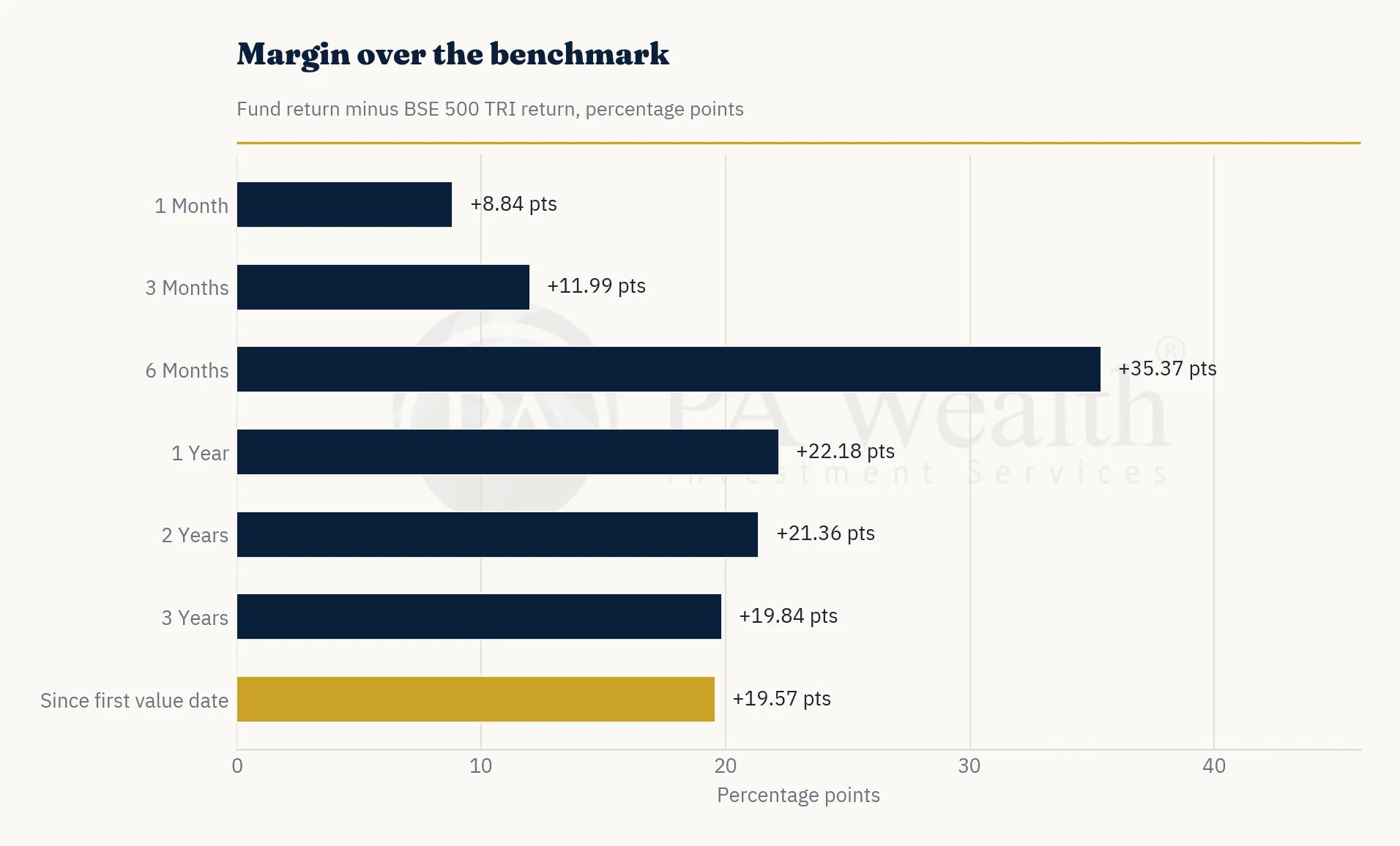
A few things stand out. The fund was ahead of the benchmark over every period shown, and in the one, two and three year windows it was also in positive territory when the benchmark was negative or modest. The 6 month figure of 43.44% is the strongest, and it is not annualised, so it should not be compared with the annualised longer-term numbers.
Since the first value date of 10 July 2023, the NAV has risen from ₹100 to ₹231.21, which works out to about 29.65% a year. This is a track record of just over three years, covering a period when small and mid cap stocks did particularly well in India, so it should not be read as a full market cycle.
(G) Risk Factors
A Category III AIF with a special situations mandate carries risks that are different from a diversified mutual fund. The main ones to understand are these.
- Unlisted holdings: About 13% of the portfolio is in unlisted equity, which is harder to value and to sell, and which is the reason for the extended redemption window.
- Liquidity: There is a 12 month lock-in, exit loads for up to 36 months and a redemption period of up to 30 business days. In-specie distribution is possible in some situations.
- Short track record: The fund has operated for about three years. The factsheet does not provide drawdown or volatility figures, so the depth of past falls cannot be assessed from it.
The Core Rule: Strong past returns show what the strategy delivered in one market phase. They are not a guide to what it will deliver next, and the right allocation depends on how much illiquidity and concentration an investor is comfortable holding.
(H) Investment Philosophy
The fund states its approach in three principles and four strategies.
- Uncovering undervalued assets: Identify undervalued opportunities across special situations, pre-IPOs and anchor book investments.
- Catalyst-driven approach: Focus on opportunities with identifiable triggers such as corporate actions, industry trends, regulatory changes or management actions.
- Risk management: Prioritise protecting capital and managing downside through disciplined due diligence and ongoing monitoring.
- Special situations: Management change, spin-offs, distressed assets, turnarounds and restructurings.
- Anchor book investments: Participating in the qualified institutional buyer portion of IPOs to benefit from price appreciation at listing.
- Pre-IPOs: Investing in SME pre-IPO opportunities ahead of listing.
- Regular value investing: Buying good quality businesses below perceived fair value from time to time.
(I) Taxability on Earnings
Tax treatment is a key difference between AIF categories. Category I and II AIFs generally pass most income through to investors. Category III AIFs, by contrast, are generally taxed at the fund level. Industry sources describe business income of a Category III fund as being taxed at the maximum marginal rate, often quoted at around 42.74%, with no pass-through of that income to investors.
The factsheet notes that the published NAV is adjusted for expenses and management fees up to the reporting date, and for performance fee and taxes on realised capital gains only up to 31 March 2025. Investors should therefore ask the manager how taxes accrued after that date will affect their net returns. Tax rules change and depend on the nature of the income, so please confirm the treatment with a qualified tax advisor and the fund’s Private Placement Memorandum before investing.
FAQs
What is the minimum investment and lock-in for the Negen Undiscovered Value Fund?
The minimum investment is ₹1 crore, which is the standard minimum for AIF investors under SEBI rules. Units are locked in for the first 12 months. After that, an exit load of 1% applies between 12 and 24 months and 0.5% between 24 and 36 months, with no exit load after 36 months. Redemption proceeds can take up to 30 business days to settle, so investors should plan for limited liquidity.
How are fees charged in this fund?
The fund charges an investment management fee of 1.1% per annum of average daily NAV and a performance fee of 11% per annum on pre-tax NAV, subject to a high watermark, with no hurdle rate. Applicable GST is added on top, and fund expenses are about 0.15% to 0.20% of contributed value. Because the performance fee is calculated on pre-tax NAV, investors should read the Private Placement Memorandum to understand exactly how it is computed.
How is a Category III AIF different from a mutual fund?
A mutual fund is open to all investors with small minimums and daily liquidity, and follows tight diversification rules. A Category III AIF is a private pooled vehicle with a ₹1 crore minimum, can use more complex strategies and, within SEBI limits, leverage. It usually has lock-ins and slower redemptions, and it is generally taxed at the fund level. This makes it suitable only for investors with higher risk capacity who understand those trade-offs.
Disclaimer: This article is for information and education only and is not investment advice or an offer or solicitation to invest in any product. Investments in securities, including AIFs, are subject to market and other risks. There are no guaranteed or assured returns, and past performance is not indicative of future performance. Performance information is based on the fund’s factsheet and is not verified by SEBI. Please read the Private Placement Memorandum and other fund documents carefully, and consult your financial and tax advisors before investing.