What Does an Investment Advisor Do?
An Investment Advisory service helps investors evaluate investment opportunities through research, financial analysis, risk assessment and goal-based guidance. An investment advisor does more than simply suggest where to invest. The role involves understanding an investor’s objectives, evaluating suitable opportunities and helping make informed investment decisions.
Investors often have different financial goals, investment horizons and risk tolerance levels. Therefore, an investment approach that works for one person may not necessarily be suitable for another. Professional guidance can help investors bring these factors together when evaluating investment opportunities.
What Is Investment Advisory?
Investment Advisory refers to professional guidance designed to help investors make informed investment decisions. The process may involve understanding financial objectives, assessing risk, researching investment opportunities and developing an approach that suits the investor’s requirements.
A research-driven advisory process can examine companies, sectors, financial performance, valuations and market conditions before forming an investment view.
Investment Advisory should not be confused with a promise of returns. Market-linked investments carry risks, and no advisor can guarantee future investment performance.
How Does an Investment Advisor Work?
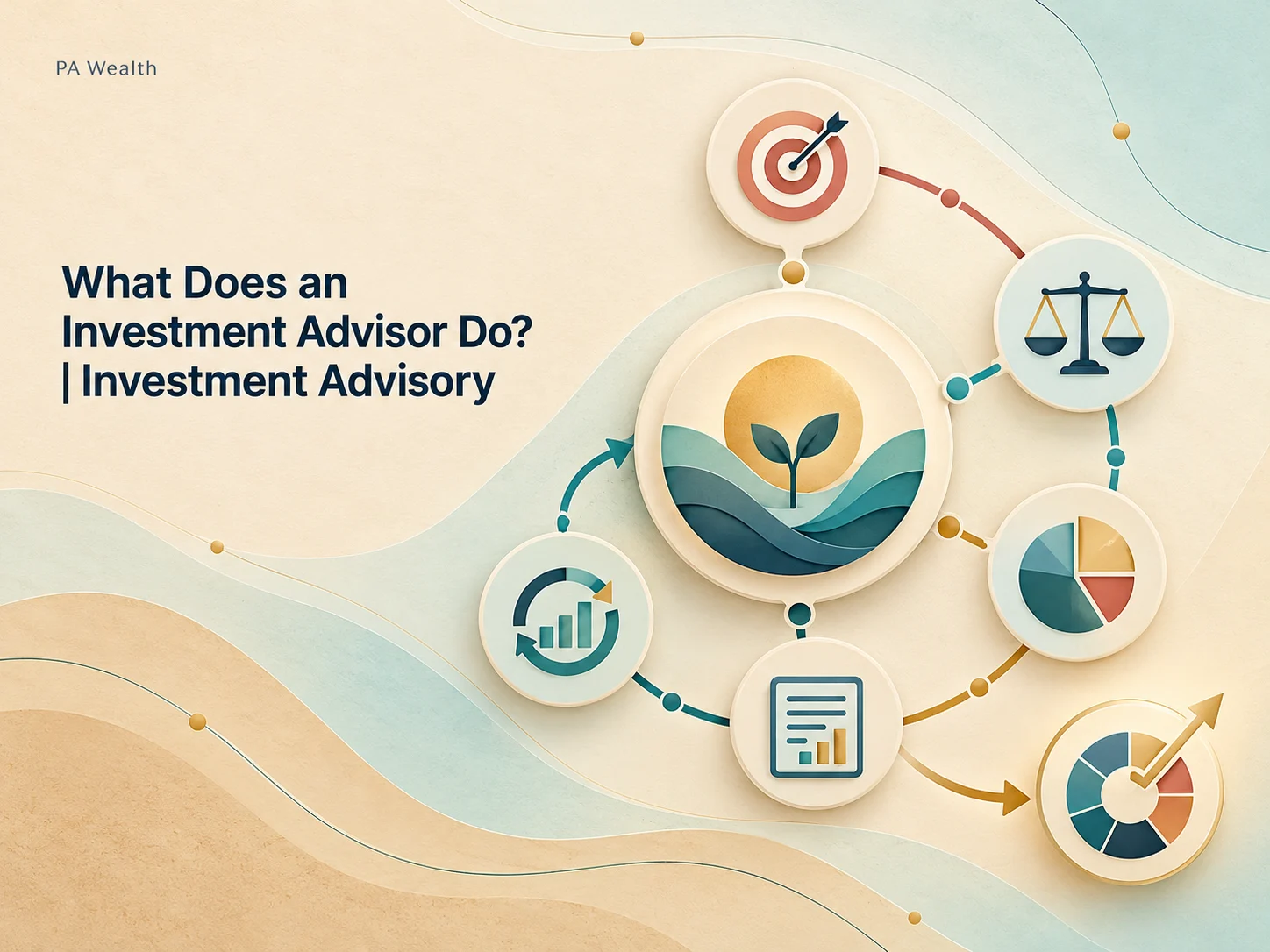
An investment advisor generally follows a structured process rather than making decisions based only on short-term market movements. The process starts by understanding the investor and then moves towards research, analysis, risk assessment and ongoing review.
The broad process can include:
- Understanding financial objectives
- Assessing investment horizon
- Understanding risk tolerance
- Researching investment opportunities
- Evaluating fundamentals and valuations
- Assessing potential risks
- Providing investment guidance
- Reviewing the investment approach when circumstances change
Why Is Investor Suitability Important?
Investment decisions should be connected to an investor’s financial circumstances. An investment that may be appropriate for a long-term investor could be unsuitable for someone who needs liquidity in the short term.
An advisor therefore needs to consider factors such as financial goals, investment horizon, risk tolerance, liquidity requirements and existing investments.
This goal-based approach helps move the discussion away from simply asking which investment may provide the highest return.
What Does an Investment Advisor Research?
Research is an important part of professional investment analysis. Depending on the investment approach, research can include company fundamentals, financial statements, industry trends, competitive positioning, management quality, valuation and potential risks.
For equity investments, fundamental analysis can help investors understand the financial and operational strength of a company.
Business Fundamentals
An advisor may examine how a company generates revenue, the products or services it offers, its customers, competitive position and the factors that could influence future growth.
Financial Performance
Revenue growth, earnings, profit margins, cash flow, debt and return ratios can provide useful information about a company’s financial health.
Industry Outlook
Industry growth, competition, regulation, technology and changing customer demand can influence the future performance of a business.
Valuation
A strong business is not automatically an attractive investment at every price. Valuation analysis helps investors understand whether the market price is reasonable relative to earnings, growth expectations and business quality.
How Does Fundamental Analysis Help Investors?
Fundamental analysis focuses on the underlying business rather than only its share-price movement. It can help investors understand whether a company’s financial performance and business model support its current market valuation.
Common areas examined during fundamental research include:
- Revenue and earnings growth
- Profitability
- Operating margins
- Operating cash flow
- Free cash flow
- Debt levels
- Return on equity
- Return on capital employed
- Competitive advantages
Why Is Valuation Important in Investment Advisory?
Valuation is another important part of investment research. Investors need to consider not only whether a business is growing but also what price they are paying for that growth.
Depending on the company and sector, analysts may consider valuation ratios such as Price-to-Earnings, Price-to-Book or enterprise-value-based measures.
Valuation should be assessed alongside growth, profitability, financial strength and business risks. A low valuation alone does not make a stock attractive, just as a high-quality business may carry valuation risk if expectations become excessive.
How Does Risk Assessment Help Investors?
Every investment involves some level of risk. An important role of an advisor is to help investors understand the risks associated with an investment rather than focusing only on its potential upside.
Risk analysis may consider:
- Market volatility
- Business-specific risks
- Industry risks
- Regulatory changes
- Economic conditions
- Debt and liquidity risks
- Valuation risks
- Changes in the original investment thesis
Understanding these factors can help investors make decisions with more realistic expectations.
What Is the Difference Between Investment Advisory and Stock Advisory?
Investment Advisory and Stock Advisory can overlap, but they are not necessarily identical in scope. Investment Advisory may involve broader investment guidance based on an investor’s objectives and risk profile, while Stock Advisory generally focuses more specifically on equity or stock-related opportunities.
Investors should understand the exact scope of services before selecting an advisory provider.
Investment Advisory vs Stock Advisory
| Factor | Investment Advisory | Stock Advisory |
|---|---|---|
| Primary Focus | Broader investment guidance based on investor objectives | Research and guidance related to stocks and equity opportunities |
| Research | May evaluate multiple investment considerations | Often focuses strongly on company and equity research |
| Risk Assessment | Considers investor risk profile and investment risks | Focuses on stock-specific and market-related risks |
| Investment Horizon | Can be aligned with the investor’s broader financial objectives | Depends on the specific stock strategy and investment thesis |
| Suitability | Can consider the investor’s overall requirements | Focuses more specifically on suitability of stock-related opportunities |
What Role Does an Investment Advisor Play in Long-Term Investing?
Long-term investing requires investors to look beyond short-term price movements. An advisor can help evaluate whether the underlying investment thesis remains valid as business conditions change.
For investors considering Best Stocks for Long Term, research may focus on sustainable earnings growth, business quality, competitive advantages, financial strength and valuation.
Regular review is also important because a company’s fundamentals, industry environment and valuation can change over time.
Can an Investment Advisor Help During Market Uncertainty?
Market uncertainty can make investment decisions more difficult. Investors may react emotionally to sharp price movements, economic news or short-term market sentiment.
A structured research process can help investors separate short-term volatility from changes that may materially affect an investment thesis.
Instead of reacting to every market movement, investors can review the underlying fundamentals, valuation and risk factors before deciding whether any action is necessary.
What Should Investors Check Before Choosing an Investment Advisor?
Investors should evaluate an advisory service carefully before subscribing. Regulatory status is important, but investors should also examine the research methodology, transparency, fees, disclosures and investor-support process.
Useful areas to check include:
- Regulatory registration and credentials
- Research methodology
- Investment approach
- Risk-management process
- Advisory fees
- Disclosure practices
- Communication process
- Investor grievance mechanism
Investors can also review the Investor Charter to understand relevant investor rights, responsibilities and information associated with investment advisory services.
Why Is Transparency Important in Investment Advisory?
Transparency helps investors understand what an advisory service provides and what risks are involved. Investors should be able to understand the applicable fees, services, disclosures and communication process before entering into an advisory relationship.
Clear communication can also help investors understand why an investment view has changed and what factors influenced the recommendation.
What Does Historical Research Tell Investors?
Historical research can provide context about how an investment thesis performed during a particular period. However, historical returns should never be treated as a prediction or guarantee of future performance.
The following examples are based on the PA Wealth research material supplied for this article and are included only to illustrate historical outcomes.
| Company | Buy Price | Holding Period | Gain Shown |
|---|---|---|---|
| BSE Ltd. | ₹123, split adjusted | 4 Years | 2,178% |
| Solar Industries | ₹1,155 | 5 Years | 1,058% |
| Polycab India Ltd. | ₹2,366 | 4 Years | 208% |
| Kirloskar Oil Engines Ltd. | ₹396 | 2.8 Years | 202% |
| Morepen Labs | ₹53 | 62 Days | 100% |
Source: Supplied PA Wealth research material. These figures represent historical performance and are provided for context only. Past performance is not indicative of future returns.
What Can Investors Learn From Past Recommendations?
Historical examples show that investment outcomes can vary considerably depending on the company, entry point, holding period, market conditions and investment thesis.
For example, the supplied research material includes multi-year outcomes as well as a shorter-duration outcome. This demonstrates why investors should not judge an advisory process only by individual historical returns.
The quality of the research process, consistency of methodology, risk assessment and suitability for the investor are also important considerations.
What Are the Common Mistakes Investors Should Avoid?
Investors can make poor decisions when they focus only on returns or follow recommendations without understanding the underlying reasoning.
- Choosing an advisor only because of past returns
- Ignoring regulatory information
- Not understanding advisory fees
- Following recommendations without understanding the risks
- Ignoring investment horizon
- Expecting guaranteed returns
- Making decisions based only on short-term market movements
- Failing to review whether the investment thesis remains valid
Key Takeaways
- An investment advisor helps investors make more informed investment decisions.
- Research and fundamental analysis are important parts of the advisory process.
- Risk assessment should accompany any discussion of investment opportunities.
- Investment decisions should consider financial goals and risk tolerance.
- Valuation is important when assessing the attractiveness of an investment.
- Past performance does not guarantee future returns.
- Investors should verify regulatory status and understand fees and disclosures.
- Investment Advisory and Stock Advisory may differ in scope and focus.
Frequently Asked Questions
What does an investment advisor do?
An investment advisor helps investors evaluate investment opportunities through research, financial analysis, risk assessment and guidance based on their objectives, investment horizon and risk profile.
What is Investment Advisory?
Investment Advisory refers to professional investment guidance that can include research, financial analysis, risk assessment and suitability-based investment decisions.
Why is research important in Investment Advisory?
Research helps evaluate business fundamentals, financial performance, industry conditions, valuation and risks before forming an investment view.
Can an investment advisor guarantee returns?
No. Market-linked investments involve risks, and past performance does not guarantee future returns. Investors should be cautious of guaranteed-return claims.
What is the difference between Investment Advisory and Stock Advisory?
Investment Advisory can involve broader investment guidance based on an investor’s objectives, while Stock Advisory generally focuses more specifically on equity and stock-related research and opportunities.
How should I choose an Investment Advisor?
Investors should evaluate regulatory status, research methodology, transparency, fees, disclosures, risk management, investor support and suitability before choosing an advisory service.
Does an investment advisor only recommend stocks?
Not necessarily. The scope of an advisory service depends on the services offered. Investors should review the advisor’s stated services and methodology before subscribing.
Conclusion
An investment advisor’s role goes beyond simply identifying an investment opportunity. A structured Investment Advisory process can combine research, fundamental analysis, valuation, risk assessment and investor suitability to support more informed decision-making.
Investors should also remember that no research process can eliminate market risk or guarantee returns. The right approach is to understand the investment thesis, evaluate the risks and consider whether the opportunity fits the investor’s financial objectives and investment horizon.
Looking for Research-Based Investment Guidance?
Explore PA Wealth Stock Advisory to learn more about research-driven approaches to evaluating investment opportunities.
About PA Wealth
PA Wealth provides expert investment services, helping investors build diversified portfolios and achieve long-term financial success.
Disclaimer
This article is provided for educational and informational purposes only and should not be considered investment advice or a recommendation to buy, sell or hold any security. Historical examples and performance figures mentioned in this article are based on supplied PA Wealth research material and are presented for context only.
Past performance is not indicative of future returns. Investments in securities are subject to market risks. Investors should consider their financial objectives, investment horizon and risk tolerance before making investment decisions. Regulatory registration, where applicable, does not guarantee investment returns.