
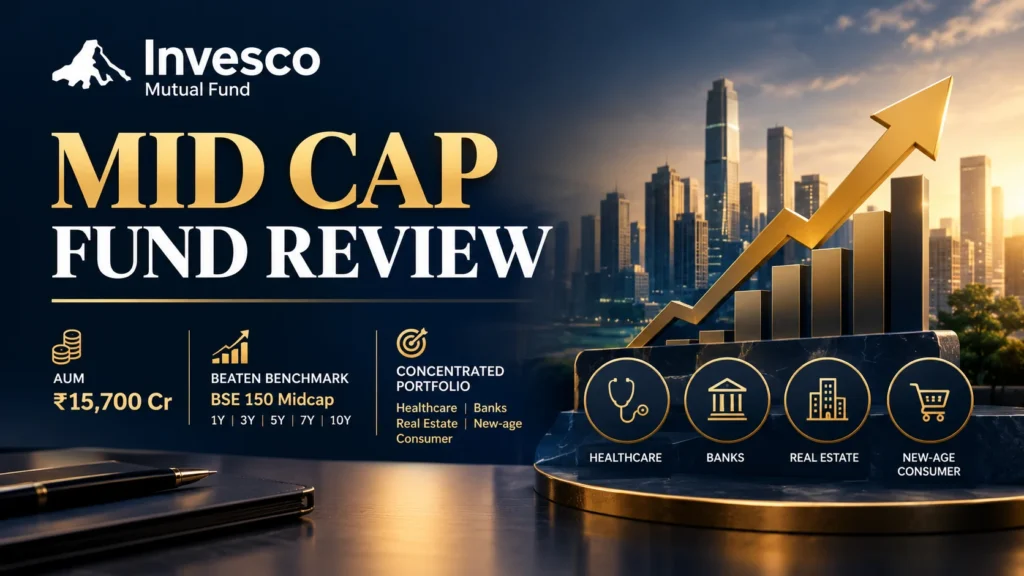
Mid caps had a rough September. According to Invesco’s own market commentary, the Nifty Midcap 100 fell 7.6% in the month, more than the Nifty 50’s 6.1% decline. Against that backdrop, the Invesco India Mid Cap Fund has held up well: it returned 7.15% over the last one year, against 3.38% for its benchmark, the BSE 150 Midcap TRI, and a loss of 7.09% for the Nifty 50 TRI. This post takes a closer look at what the fund owns, who runs it, how it has performed and what an investor should weigh before putting money in.
(A) About the Fund
The Invesco India Mid Cap Fund is an open ended equity scheme that predominantly invests in mid cap stocks. Its stated objective is to generate capital appreciation by investing predominantly in mid cap entities. The scheme was launched on 19 April 2007 as a close ended fund and was reopened for purchase on 20 April 2010, so it has a track record of more than 19 years. It is benchmarked to the BSE 150 Midcap TRI.
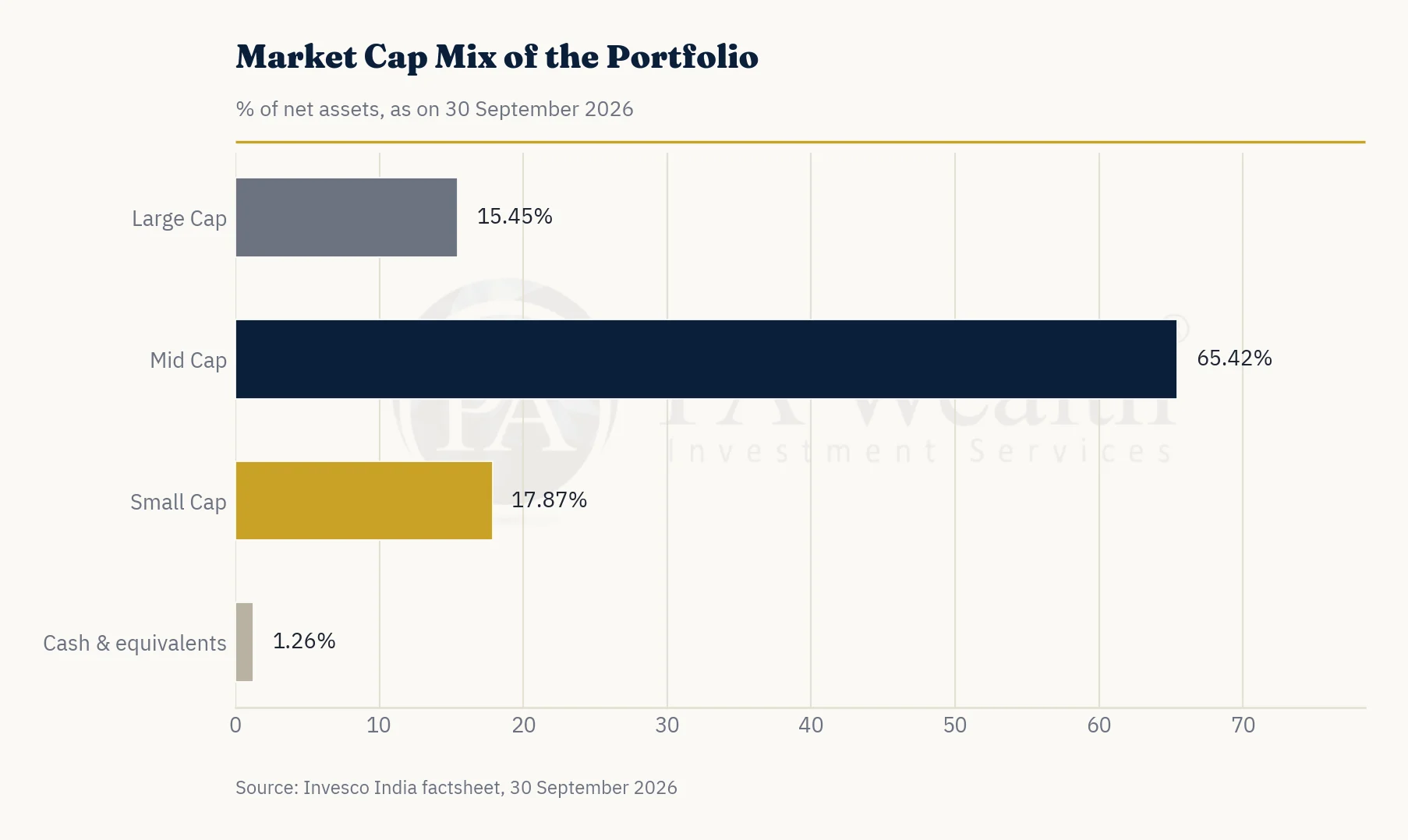
As a mid cap fund it is required to keep at least 65% of its assets in mid cap stocks, and as on 30 September 2026 it held 65.42% there. The portfolio is compact, with 43 holdings, and equity makes up 98.74% of net assets with the balance 1.26% in cash and cash equivalents.
(B) Basic Details
| Particulars | Details |
|---|---|
| Fund House | Invesco Mutual Fund |
| Category | Equity – Mid Cap |
| Launch Date | 19 April 2007 (reopened for purchase on 20 April 2010) |
| AUM (30 September 2026) | ₹15,748.83 crore |
| NAV (30 September 2026) | Regular Growth ₹189.82, Direct Growth ₹231.34 |
| Benchmark | BSE 150 Midcap TRI |
| Riskometer | Very High |
(C) Portfolio Classification
Market Cap Mix
Mid caps account for 65.42% of the portfolio, large caps for 15.45% and small caps for 17.87%. The fund therefore keeps a meaningful buffer of larger companies, while also taking a nearly 18% exposure to the smaller end of the market.
Top 10 Holdings
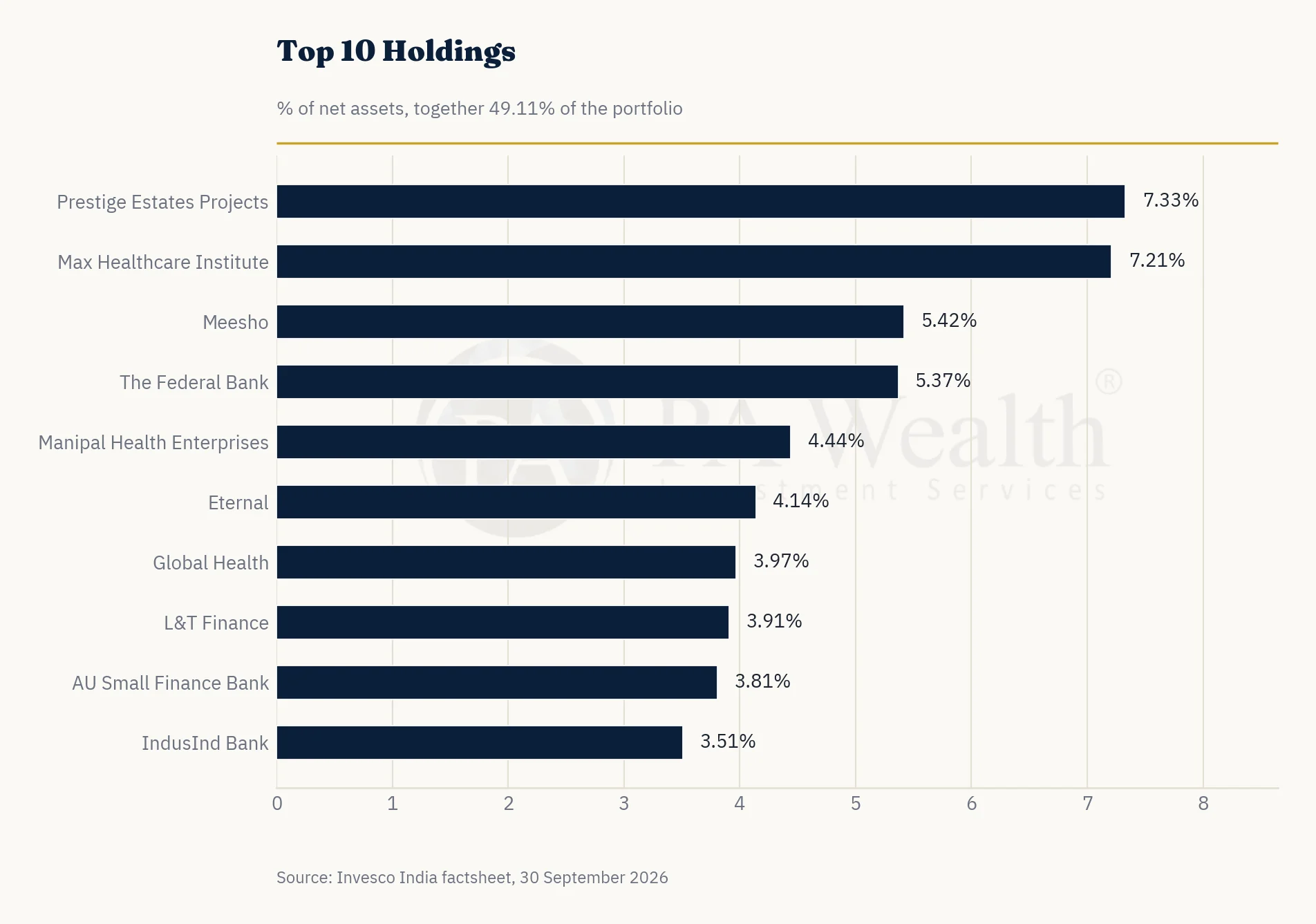
The ten largest holdings together make up 49.11% of net assets, which is a fairly concentrated profile for a mid cap fund. Prestige Estates Projects (7.33%) and Max Healthcare Institute (7.21%) are the two largest positions, followed by Meesho (5.42%) and The Federal Bank (5.37%).
Top 10 Sector Exposure
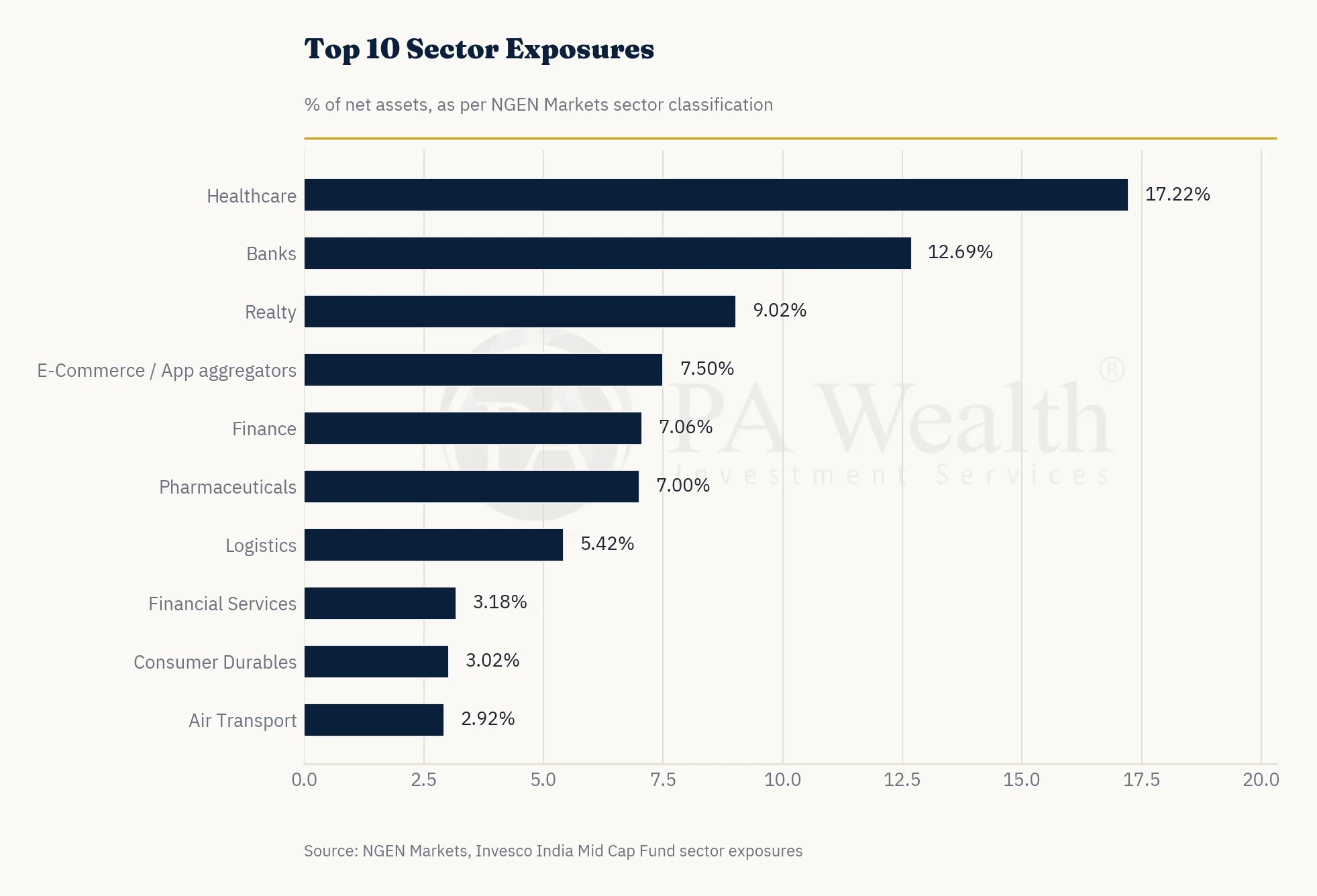
Healthcare is the single largest sector at 17.22%, led by hospital chains such as Max Healthcare, Manipal Health and Global Health. Banks (12.69%) and realty (9.02%) come next. Looking at related groups together, healthcare and pharmaceuticals add up to 24.22% of the portfolio, while banks, finance, financial services and insurance add up to 24.45%. The four new age consumer platforms in the portfolio, Eternal, Meesho, FSN E-Commerce (Nykaa) and Swiggy, together account for 12.92%.
On valuation, the portfolio’s weighted P/E on FY27 estimates is 37.69 and its price to book is 4.17, as reported in the factsheet. The portfolio turnover ratio for the last year is 0.27, which points to a low churn, buy and hold style.
(D) Fund Manager and Tenure
The fund is managed by Aditya Khemani, who has 19 years of total experience. He has managed this scheme since 9 November 2023. Until January 2026 he shared the equity responsibilities with Amit Ganatra; from 28 January 2026 Mr. Khemani has been the sole equity fund manager of the scheme. He holds a B.Com (Hons) and a PGDM from IIM Lucknow, and earlier worked in equity research roles at firms including SBI Funds Management, Prudential ICICI Asset Management and HSBC Asset Management.
One point worth keeping in mind: the fund’s 7 year and 10 year numbers include a period before Mr. Khemani took charge, so the longer track record cannot be attributed to the current manager alone.
(E) Investment Details
| Particulars | Details |
|---|---|
| Minimum Lumpsum | ₹100 and in multiples of ₹1 thereafter |
| Additional Purchase | ₹100 and in multiples of ₹1 thereafter |
| Exit Load | Nil for up to 10% of units redeemed or switched out within 1 year; 1% on units in excess of 10% redeemed within 1 year; Nil after 1 year |
| Lock-in | None |
| Expense Ratio (base) | Regular Plan 1.44%, Direct Plan 0.49% |
(F) Returns Generated
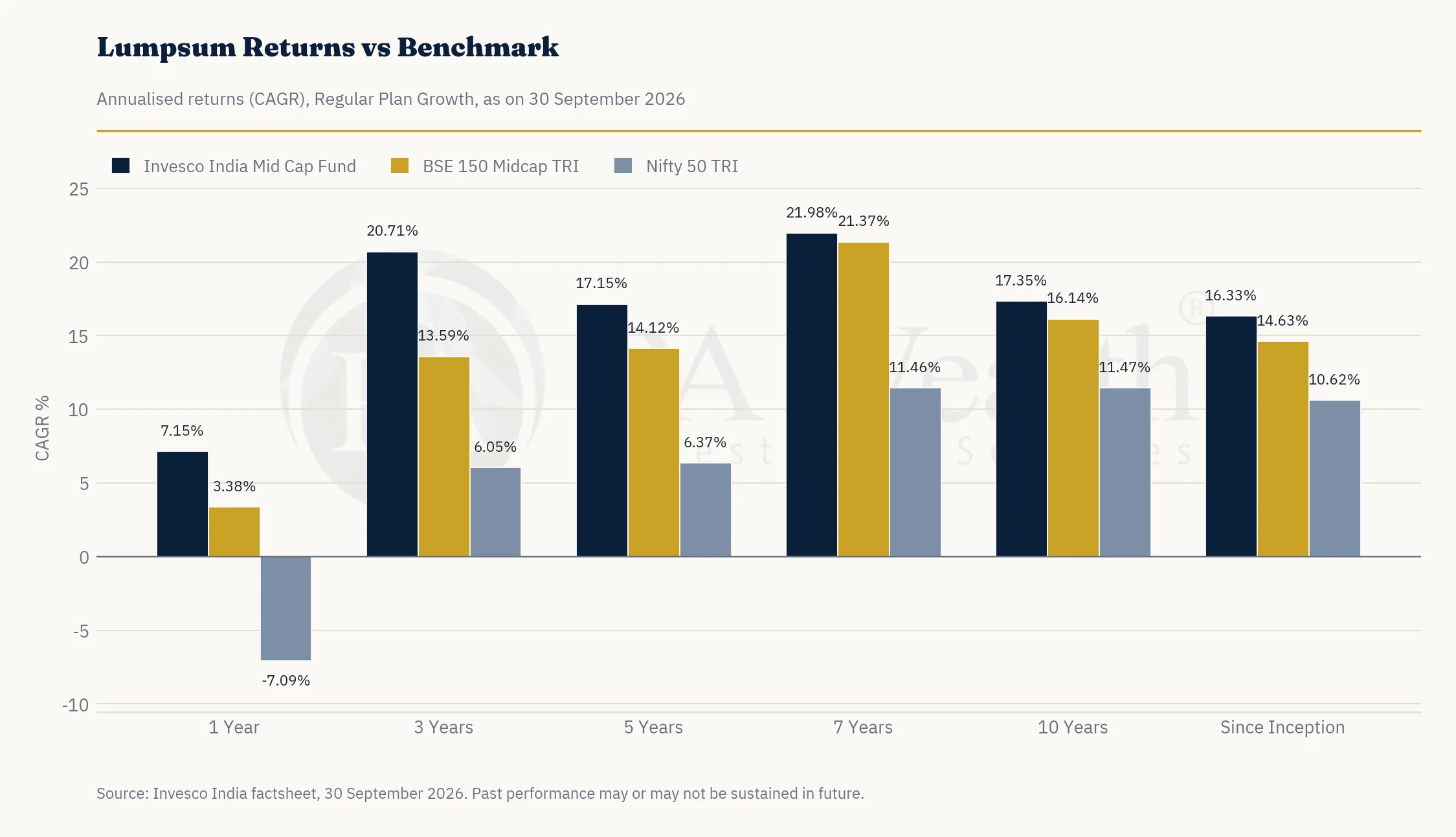
The fund has beaten its benchmark over every period shown in the factsheet. The margin is widest over three years (20.71% against 13.59%) and narrows over seven years (21.98% against 21.37%). Since inception, it has delivered 16.33% a year, against 14.63% for the benchmark.
| Period | Fund (CAGR) | BSE 150 Midcap TRI | Nifty 50 TRI | ₹10,000 invested in the fund became |
|---|---|---|---|---|
| 1 Year | 7.15% | 3.38% | -7.09% | ₹10,715 |
| 3 Years | 20.71% | 13.59% | 6.05% | ₹17,609 |
| 5 Years | 17.15% | 14.12% | 6.37% | ₹22,077 |
| 7 Years | 21.98% | 21.37% | 11.46% | ₹40,216 |
| 10 Years | 17.35% | 16.14% | 11.47% | ₹49,561 |
| Since Inception (19 April 2007) | 16.33% | 14.63% | 10.62% | ₹1,89,820 |
SIP Returns
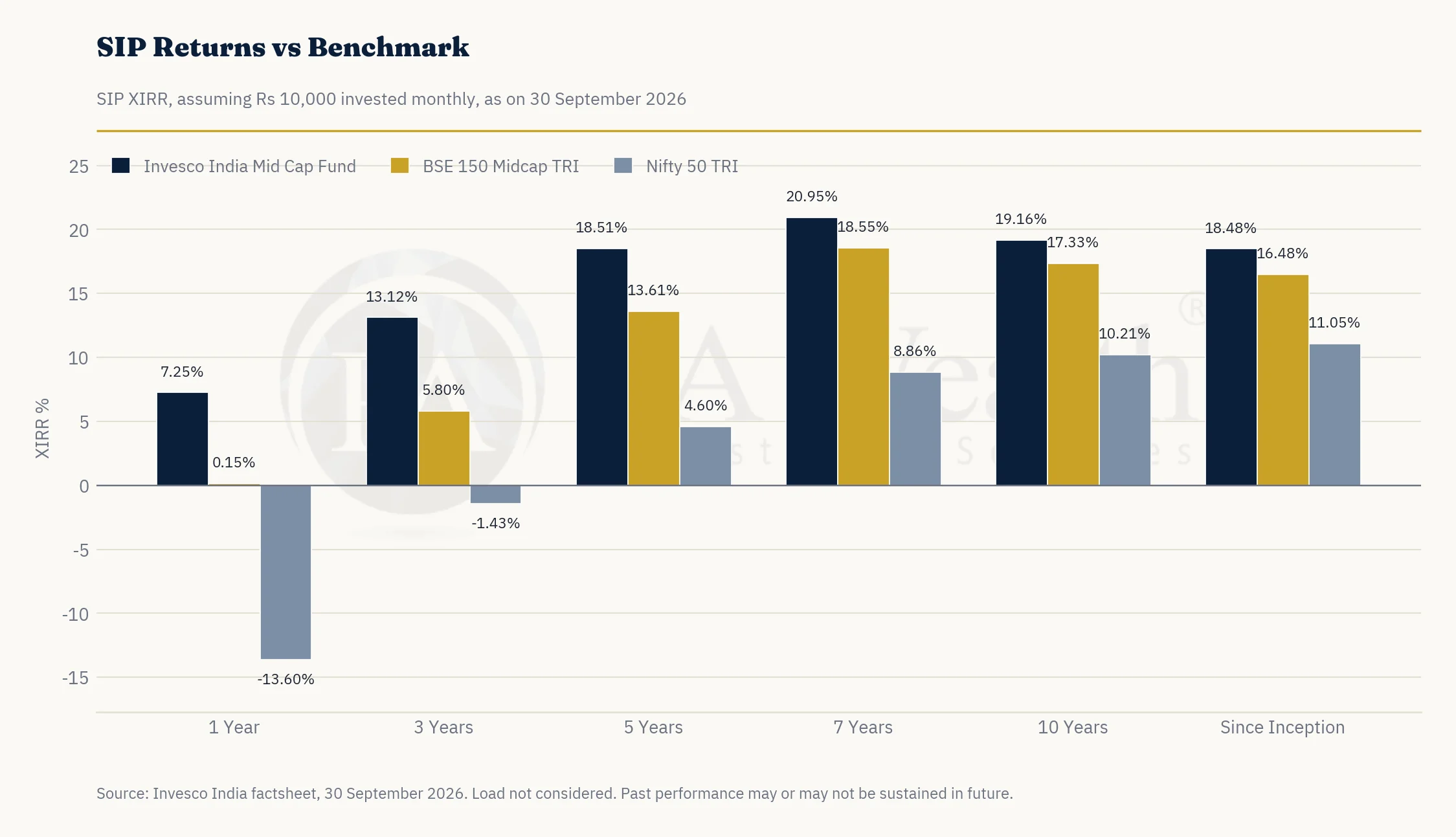
For investors who invest every month, the story is similar. A monthly SIP of ₹10,000 over the last 10 years (a total investment of ₹12,00,000) grew to ₹32,89,564, an XIRR of 19.16%, against 17.33% for the benchmark. Since inception, a total SIP investment of ₹23,40,000 has grown to ₹1,87,49,264, an XIRR of 18.48%. The first SIP instalment for the since inception figure is taken as 1 May 2010, as the scheme was close ended before that.
(G) Risk Factors
The fund carries a Very High riskometer rating, and mid cap funds as a group are more volatile than large cap funds. September’s 7.6% fall in the Nifty Midcap 100 is a reminder of how quickly the segment can move. Over three years, using monthly data points, the fund’s standard deviation is 5.80%, its beta is 1.03 and its Sharpe ratio is 0.23 (using a risk free rate of 5.24%). A beta of 1.03 means the fund has moved broadly in line with the market, not with less risk than it.
- Concentration: The top 10 stocks make up 49.11% of the fund and one sector, healthcare, is over 17%. A setback in a few names or in one theme can have an outsized effect.
- Interest rate sensitivity: Realty, banks and financials together form a large part of the portfolio. Invesco’s own commentary notes that the RBI has begun raising rates and moved to a stance of calibrated tightening, with further hikes possible.
- Valuation: A portfolio P/E of 37.69 on FY27 estimates leaves less room for disappointment if earnings fall short.
(H) Investment Philosophy
- The fund follows a process based approach and keeps strictly to its mandate of investing predominantly in mid cap companies.
- Stock selection combines bottom up research with a top down view, with no fixed style bias.
- Invesco uses a proprietary framework to sort stocks into growth and value buckets.
- Invesco’s head of equities has said that the firm believes equity markets are not fully efficient, and that strong in house research combined with a disciplined process can generate alpha.
- The portfolio is held with conviction, with 43 stocks and a low turnover ratio of 0.27.
(I) Taxability on Earnings
The Invesco India Mid Cap Fund is an equity oriented scheme, so gains are taxed as follows under the current rules:
- Short term capital gains: Units sold within 1 year are taxed at 20% on the gain.
- Long term capital gains: Units sold after 1 year are taxed at 12.5% on gains above ₹1,25,000 in a financial year. Gains up to ₹1,25,000 are exempt.
- IDCW: Income distribution cum capital withdrawal payouts are added to your income and taxed at your applicable slab rate.
Surcharge and cess are extra where applicable. Tax rules can change, so please check with your tax advisor.
Who Should Consider This Fund
A mid cap fund of this kind suits investors with a high risk appetite and a horizon of at least 7 years, who can stay invested through sharp falls like the one seen in September. It works best as a growth satellite alongside a core large cap or flexi cap allocation, not as the only equity holding. Staggering entry through a SIP or an STP is one way to manage timing risk in a volatile segment.
Disclaimer: Mutual fund investments are subject to market risks, read all scheme related documents carefully. Past performance may or may not be sustained in future. This article is for information and education only. It is not investment advice or a recommendation to buy, sell or hold any scheme. Please consult your financial advisor before investing.