Criteria for SEBI-Registered Investment Advisors: What Should Investors Check?
How do you know whether an investment advisor meets the regulatory requirements in India? For investors comparing professional investment guidance, understanding the Criteria for SEBI-Registered Investment Advisors is an important first step.
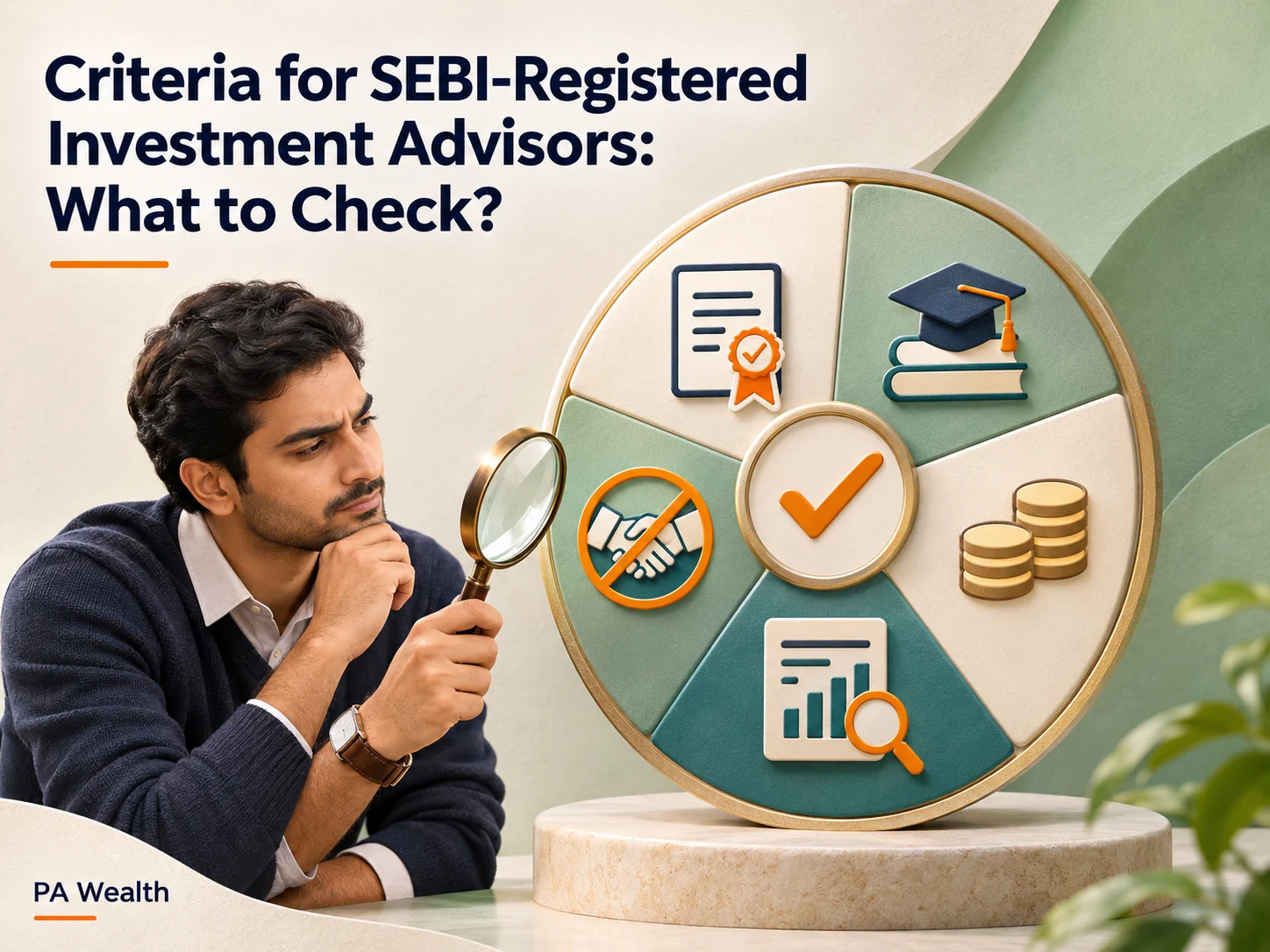
SEBI’s framework for Investment Advisers covers areas such as registration, qualification and certification, net-worth requirements, risk profiling, suitability, disclosures, records and conduct. These requirements are designed to create a regulatory framework for investment advisory activities and protect investor interests.
However, SEBI registration should not be interpreted as a guarantee of investment performance. Market-linked investments remain subject to risk, and investors should evaluate both the regulatory status and the quality of the service before making a decision.
This guide explains the major criteria investors should understand when evaluating a SEBI-registered Investment Adviser.
Table of Contents
- What Is a SEBI-Registered Investment Advisor?
- Why Do SEBI Registration Criteria Matter?
- What Are the Key Criteria for SEBI-Registered Investment Advisors?
- What Qualifications Are Required?
- What Certification Is Required?
- What Is the Net-Worth Requirement?
- Why Does Professional Experience Matter?
- What Does the Registration Process Consider?
- How Do Risk Profiling and Suitability Work?
- Why Are Disclosures Important?
- What Should Investors Check Before Choosing an Advisor?
- SEBI Registration vs Investment Performance
- Common Mistakes Investors Should Avoid
- Investor Checklist
- FAQs
What Is a SEBI-Registered Investment Advisor?
An Investment Adviser is a person or entity that, for consideration, is engaged in the business of providing investment advice. Under the SEBI framework, Investment Advisers are subject to regulatory requirements relating to registration, qualification, certification, risk profiling, suitability, disclosures and record maintenance. :chatgpt-content-reference{index=”1″}
For an investor, this means that choosing a registered adviser is different from simply following financial content published online or taking an informal stock tip.
Investors should still understand the exact scope of the service. Registration establishes regulatory status; it does not mean that every recommendation will be profitable or that investment losses cannot occur.
Why Do SEBI Registration Criteria Matter?
Investment decisions can involve significant financial consequences. A regulatory framework helps establish requirements that an Investment Adviser must meet while carrying out advisory activities.
SEBI’s Investment Adviser framework includes requirements concerning qualifications, certification, risk profiling, suitability, disclosures, records and conduct. :chatgpt-content-reference{index=”2″}
For investors, these requirements provide a useful starting point when evaluating whether a person or organisation is operating within the relevant regulatory framework.
What Are the Key Criteria for SEBI-Registered Investment Advisors?
The criteria are broader than simply obtaining a registration certificate. Investors should understand several areas when evaluating a registered Investment Adviser.
- Regulatory registration
- Professional qualifications
- Relevant certification
- Applicable net-worth requirements
- Fit-and-proper requirements
- Risk profiling
- Suitability of advice
- Conflict-of-interest disclosures
- Record maintenance
- Investor disclosures and transparency
These requirements work together rather than functioning as separate quality guarantees.
What Qualifications Are Required?
SEBI’s current framework specifies qualification requirements for an individual Investment Adviser and the principal officer of a non-individual Investment Adviser.
The qualifying routes include specified professional qualifications or graduate or postgraduate-level qualifications in relevant areas such as finance, accountancy, business management, commerce, economics, capital markets, banking, insurance or actuarial science.
The framework also recognises certain professional routes, including the NISM Post Graduate Program in the Securities Market with an Investment Advisory specialisation and the CFA Charter, subject to the applicable requirements. :chatgpt-content-reference{index=”3″}
This means investors should not evaluate an adviser only by general financial experience. Relevant qualifications and regulatory requirements also matter.
What Certification Is Required?
Qualification and certification are separate parts of the regulatory framework.
Individuals providing investment advice are required to maintain the applicable certification relating to financial planning, fund or asset or portfolio management, or investment advisory services. The certification can be obtained from NISM or another organisation or institution where the certification is accredited by NISM, as provided under the regulations. :chatgpt-content-reference{index=”4″}
For investors, this highlights why checking an adviser’s professional credentials can be more useful than relying only on marketing claims.
What Is the Net-Worth Requirement?
The SEBI framework also prescribes minimum net-worth requirements for Investment Advisers.
Under the applicable framework, the minimum net worth is ₹5 lakh for an individual applicant and ₹50 lakh for a non-individual applicant. :chatgpt-content-reference{index=”5″}
Net worth is a regulatory eligibility requirement. It should not be interpreted as evidence that an adviser will generate better investment returns.
Why Does Professional Experience Matter?
Investment advice involves evaluating financial products, securities and investment-related risks. Experience therefore forms an important part of the regulatory framework.
Investors should distinguish between general employment experience and experience that is relevant to financial products, securities, fund or asset management, portfolio management or investment advice.
The regulatory qualification framework has evolved over time, so investors and applicants should refer to the latest SEBI regulations and applicable circulars rather than relying on older articles describing previous requirements. :chatgpt-content-reference{index=”6″}
What Does the Registration Process Consider?
Registration is not simply about submitting an application. The regulatory framework requires the applicant to meet applicable conditions for registration.
Among other considerations, the Board takes into account matters relevant to granting a certificate of registration, including whether the applicant, partners, principal officer and persons associated with investment advice meet the applicable fit-and-proper criteria. :chatgpt-content-reference{index=”7″}
This is important because the regulatory framework considers the people involved in providing investment advice, not merely the name of the organisation.
How Do Risk Profiling and Suitability Work?
One of the important investor-protection elements of the Investment Adviser framework is the assessment of the client’s circumstances before providing suitable advice.
Risk profiling helps understand how much investment risk may be appropriate for a particular investor. Suitability then connects the investment recommendation with the client’s objectives, risk profile and relevant circumstances.
For investors, this means that professional advisory should not simply be about identifying an attractive investment. The recommendation also needs to be considered in the context of the investor for whom it is being provided.
SEBI materials specifically identify risk profiling and suitability of advice among the safeguards associated with the Investment Adviser framework. :chatgpt-content-reference{index=”8″}
Why Are Disclosures Important?
Transparency is an important part of evaluating any financial service.
Investors should understand the nature of the service, applicable fees, relevant risks and potential conflicts of interest before entering into an advisory relationship.
SEBI’s framework includes requirements relating to disclosure of conflicts of interest and maintenance of records concerning client assessment and suitability of advice. :chatgpt-content-reference{index=”9″}
Clear disclosures can help investors understand what an adviser does and what the adviser does not guarantee.
What Should Investors Check Before Choosing an Advisor?
Investors should not stop at seeing the words “SEBI Registered” on a website or social-media profile. They should independently verify the registration information and then evaluate the service itself.
A practical checklist includes:
- Verify the adviser’s registration details.
- Check the name of the registered entity.
- Understand the scope of advisory services.
- Review professional qualifications and applicable certifications.
- Understand the fee structure.
- Read relevant disclosures.
- Understand how risk profiling is conducted.
- Check how suitability is considered.
- Review the adviser’s approach to conflicts of interest.
- Understand how records and client information are handled.
This approach helps investors evaluate both regulatory compliance and the practical quality of the service.
SEBI Registration vs Investment Performance
SEBI registration and investment performance are two different concepts.
| Factor | What It Tells an Investor |
|---|---|
| SEBI registration | Indicates that the entity is registered under the applicable regulatory framework. |
| Qualification | Shows that applicable professional education requirements are addressed. |
| Certification | Demonstrates compliance with applicable certification requirements. |
| Risk profiling | Helps assess the investor’s risk characteristics. |
| Suitability | Helps relate advice to the client’s circumstances. |
| Disclosures | Help investors understand fees, conflicts, risks and service terms. |
| Investment performance | Can vary and is not guaranteed by registration. |
The distinction is important. A regulated adviser still operates in a market where investment outcomes are uncertain.
What Is the Difference Between an Investment Advisor and a Stock Tip Provider?
Investors can receive market information from many sources, including social media, websites, messaging groups and informal communities.
However, an informal stock tip and regulated investment advisory are not automatically equivalent.
Professional advisory operates within an applicable regulatory framework and involves requirements around areas such as registration, qualifications, risk profiling, suitability and disclosures.
Investors should therefore look beyond a recommendation itself and understand who is providing it, under what framework and with what disclosures.
Why Should Investors Check the Investor Charter?
Investor rights and responsibilities are an important part of the relationship between investors and regulated financial service providers.
Investors can review the relevant Investor Charter to understand applicable information about investor rights and responsibilities.
Reading the available disclosures before subscribing to an advisory service can help investors make a more informed decision.
Common Mistakes Investors Should Avoid
Even when investors choose a regulated adviser, they should avoid assuming that regulation eliminates investment risk.
- Assuming SEBI registration guarantees returns
- Choosing an adviser only because of past performance
- Ignoring fees and service terms
- Not checking registration details independently
- Following recommendations without understanding the risks
- Assuming every investor should receive the same advice
- Ignoring disclosures about conflicts of interest
- Confusing financial education with personalised investment advice
Practical Checklist for Investors
Before choosing a SEBI-registered Investment Adviser, investors can ask these questions:
- Is the adviser currently registered under the applicable SEBI framework?
- Can the registration details be independently verified?
- Does the adviser meet applicable qualification and certification requirements?
- Are the fees clearly explained?
- Are conflicts of interest disclosed?
- How is risk profiling conducted?
- How is suitability of advice assessed?
- What records and disclosures are maintained?
- What exactly is included in the advisory service?
- Are investment risks clearly communicated?
Key Takeaways
- The criteria for SEBI-registered Investment Advisers cover more than registration alone.
- Qualifications and applicable professional certifications are important regulatory requirements.
- Minimum net-worth requirements apply to individual and non-individual applicants.
- Risk profiling and suitability are important investor-protection elements.
- Investors should review disclosures, fees and conflicts of interest.
- SEBI registration does not guarantee investment returns or eliminate market risk.
Frequently Asked Questions
What are the criteria for SEBI-registered Investment Advisors?
The criteria include applicable registration conditions, professional qualifications, certifications, net-worth requirements and regulatory obligations relating to risk profiling, suitability, disclosures, records and conduct.
What qualification is required to become a SEBI-registered Investment Advisor?
The applicable framework specifies professional or academic qualifications in relevant financial fields. Certain recognised routes include relevant graduate or postgraduate qualifications, the NISM Post Graduate Program in the Securities Market with an Investment Advisory specialisation, or a CFA Charter, subject to applicable requirements. :chatgpt-content-reference{index=”10″}
Is certification mandatory for an Investment Advisor?
Yes, applicable persons associated with investment advice must maintain the prescribed certification relating to financial planning, fund or asset or portfolio management or investment advisory services from NISM or another permitted and appropriately accredited institution, as specified under the framework. :chatgpt-content-reference{index=”11″}
What is the minimum net worth for a SEBI Investment Advisor?
The applicable framework provides for minimum net worth of ₹5 lakh for an individual applicant and ₹50 lakh for a non-individual applicant. :chatgpt-content-reference{index=”12″}
Does SEBI registration guarantee investment returns?
No. SEBI registration is a regulatory status and does not guarantee profits or investment performance. Equity and other market-linked investments remain subject to risk.
Why is risk profiling important?
Risk profiling helps understand an investor’s risk characteristics and provides an important basis for considering whether an investment recommendation is suitable for that investor.
How can investors verify an Investment Advisor?
Investors should independently verify the adviser’s current registration details through official SEBI resources and review the provider’s disclosures, service scope and applicable terms before subscribing.
What should investors check besides SEBI registration?
Investors should also review qualifications, certifications, fees, disclosures, conflicts of interest, risk-profiling processes, suitability practices and the actual scope of advisory services.
Can a SEBI-registered Investment Advisor guarantee profits?
No. A registered adviser cannot turn market uncertainty into guaranteed returns. Investors should be cautious of claims suggesting assured profits or risk-free investment outcomes.
Are SEBI registration criteria the same as investment performance criteria?
No. Registration criteria concern regulatory eligibility and compliance. Investment performance depends on market conditions, business outcomes, valuation and many other factors. Registration should therefore not be treated as a performance guarantee.
Conclusion
Understanding the Criteria for SEBI-Registered Investment Advisors helps investors look beyond marketing claims and evaluate an advisory service more carefully.
Registration, qualifications, certification, net worth, risk profiling, suitability and disclosures are important parts of the regulatory framework. At the same time, investors should remember that regulation does not eliminate investment risk or guarantee future returns.
A better approach is to verify regulatory information, understand the service, review disclosures and fees, and make sure the advisory relationship fits the investor’s own objectives and circumstances.
About PA Wealth
PA Wealth publishes research-led educational content covering investment advisory, stock research and related investment topics. The objective is to help investors understand important considerations before making investment decisions.
Disclaimer
Disclaimer: The information in this article is provided for educational and informational purposes only and should not be considered investment advice or a recommendation to buy or sell any security. Regulatory requirements may change, and readers should refer to the latest official SEBI regulations and circulars for current requirements. Past performance does not guarantee future returns. Investors should conduct their own research and consult a qualified investment advisor before making investment decisions. Investments in securities are subject to market risks. Read all related documents carefully before investing.