Stock Advisory: How Does It Help Investors Make Better Decisions?
Should you choose a stock because it is trending, because someone recommended it, or because its recent performance looks attractive? These questions explain why many investors explore Stock Advisory before making investment decisions.
Stock selection involves more than looking at a company’s share price. Investors may need to understand the underlying business, financial performance, valuation, industry conditions, competitive position and potential risks. A structured research process can make these factors easier to evaluate.
However, Stock Advisory should not be confused with a promise of profits. Market-linked investments involve uncertainty, and no advisory service can guarantee future returns. The value of professional research lies in providing a disciplined framework for evaluating investment opportunities.
For beginners, experienced investors and high-net-worth individuals alike, understanding how stock research works can help them ask better questions before choosing an advisory service or making an investment decision.
Table of Contents
- What Is Stock Advisory?
- How Does Stock Advisory Work?
- Why Do Investors Consider Stock Advisory Services?
- What Research Goes Into Stock Selection?
- How Does Fundamental Analysis Help Investors?
- Why Do Valuation, Earnings and Cash Flow Matter?
- Stock Advisory vs Generic Stock Tips
- Stock Advisory vs DIY Investing
- What Should Investors Check Before Choosing a Service?
- What Role Does a Stock Market Advisor Play?
- What Is the Role of a SEBI Registered Investment Advisor?
- Can Stock Advisory Support Long-Term Investment Decisions?
- What About Stocks to Buy Now?
- What About Best Stocks for Long Term?
- Should Investors Look for Multibagger Stocks?
- Investor Rights, Responsibilities and Investor Charter
- Common Mistakes Investors Should Avoid
- Practical Checklist Before Choosing Stock Advisory Services
- Key Takeaways
- Frequently Asked Questions
What Is Stock Advisory?
Stock Advisory refers to a research-led approach to evaluating equity investment opportunities. Depending on the service, it may involve company research, financial analysis, valuation assessment, risk evaluation and investment-related guidance.
The exact scope can differ between providers. Some services may focus primarily on research, while others may provide more structured guidance based on an investor’s objectives and circumstances.
The important distinction is that professional stock research is not simply about predicting which share price will rise next. It involves understanding the business behind the stock and the factors that could influence its future performance.
Why Does This Matter to Investors?
An investor may see a stock rising sharply and assume that the trend will continue. Another investor may see a stock trading at a lower valuation and immediately consider it a bargain.
Both approaches can overlook important questions. What is driving the business? Are earnings sustainable? Is cash being generated? What risks could change the investment case?
A research-led process attempts to answer these questions before an investment decision is made.
How Does Stock Advisory Work?
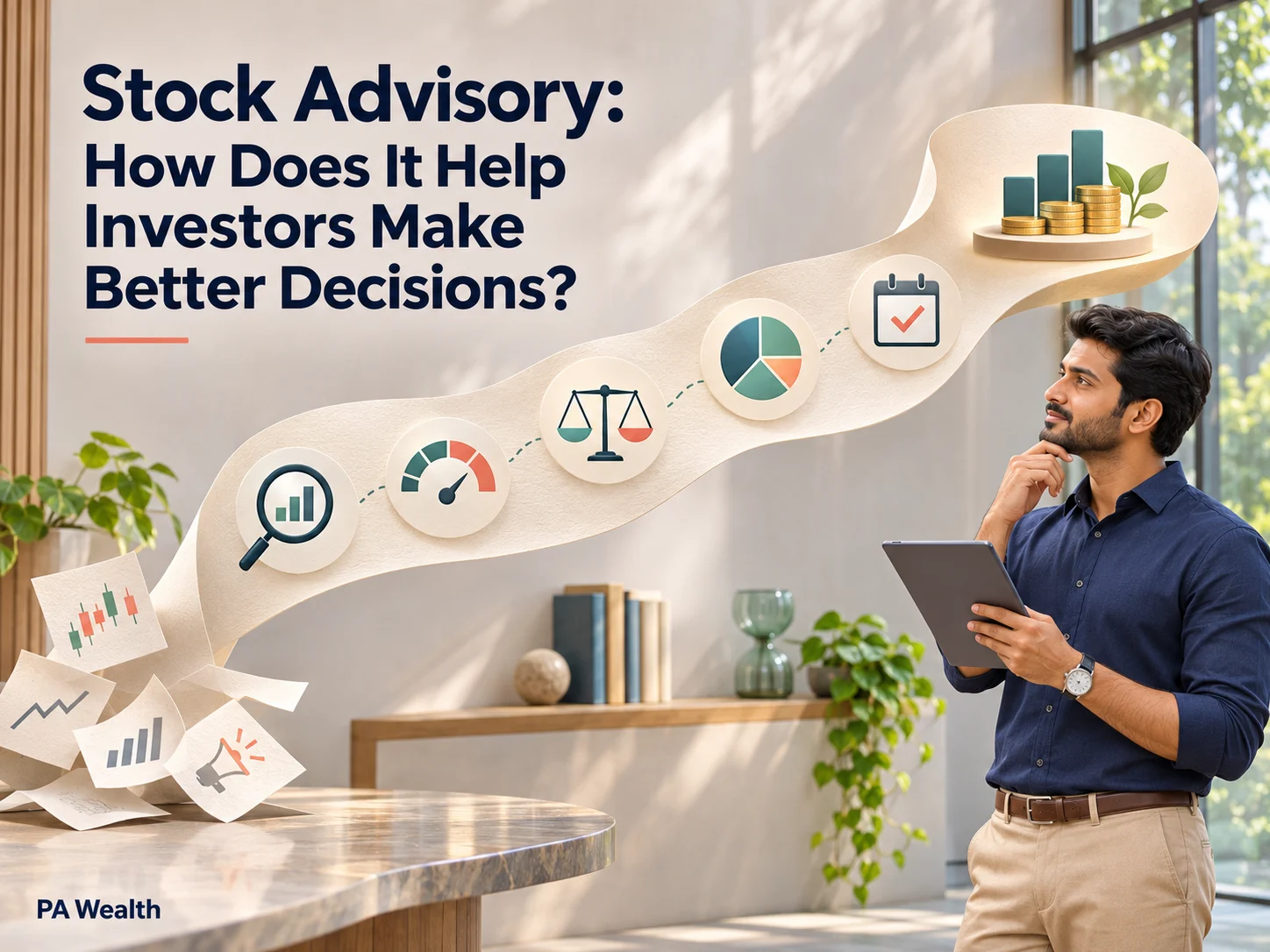
A structured Stock Advisory process generally begins with research rather than a stock tip. The objective is to understand the company, evaluate its financial and business characteristics, and identify the factors that could influence the investment thesis.
The process may include several stages:
- Understanding the business: Examine how the company generates revenue and what drives demand.
- Studying financial performance: Review revenue, earnings, margins and cash generation.
- Evaluating valuation: Consider how the market price compares with business fundamentals and expectations.
- Assessing risks: Identify business, industry, financial and market-related risks.
- Reviewing the investment thesis: Determine which factors support or challenge the case for further research.
- Monitoring developments: Reassess the thesis when important business or market conditions change.
This does not remove uncertainty. Instead, it creates a more systematic way of thinking about an investment.
Why Do Investors Consider Stock Advisory Services?
Investors may consider stock advisory services for different reasons.
Some investors have limited time to analyse financial statements and company developments. Others may understand markets but prefer an independent research framework before making decisions.
Beginners may also find structured research useful because financial terminology and valuation concepts can be difficult to interpret without context.
For experienced investors, research support may help organise information and highlight factors that deserve further examination.
However, an investor should not assume that using an advisory service removes the need for personal judgment. Understanding the investment thesis, risks and suitability remains important.
What Research Goes Into Stock Selection?
Good stock selection requires more than one metric. A company’s financial statements, business model, competitive environment and industry outlook can all influence the investment case.
Business Quality
Investors should first understand how the company makes money and why customers choose its products or services.
Questions can include:
- What are the company’s main revenue sources?
- Is customer demand sustainable?
- How competitive is the market?
- Does the business have meaningful barriers to entry?
- What could weaken its market position?
A clear understanding of the business provides context for the financial numbers that follow.
Revenue and Earnings
Revenue growth can indicate increasing demand, but growth alone does not establish investment quality.
Investors should examine whether revenue growth is translating into sustainable earnings and whether profitability is improving, stable or under pressure.
The source of growth also matters. Temporary factors can produce a different quality of growth from recurring customer demand or expansion in the core business.
Cash-Flow Generation
Profitability is important, but investors should also understand how effectively a business converts its operations into cash.
Operating cash flow can provide insight into cash generated through normal business activities. Free cash flow can offer another perspective after considering necessary capital expenditure.
Consistent cash generation can provide a company with greater flexibility to reinvest, manage obligations and respond to changing conditions.
How Does Fundamental Analysis Help Investors?
Fundamental analysis examines the financial and business characteristics of a company to understand its underlying strength and potential risks.
It may include analysis of:
- Revenue and earnings
- Profit margins
- Operating cash flow
- Debt and liabilities
- Return measures
- Capital allocation
- Competitive advantages
- Industry conditions
The purpose is not to produce a single number that automatically determines whether a stock should be bought.
Instead, these factors help investors develop a more complete view of the business and identify areas that require further research.
Why Do Valuation, Earnings and Cash Flow Matter?
A company can have strong earnings growth and still be an unattractive investment if the market price already reflects very high expectations.
This is why valuation needs to be considered alongside business performance.
Valuation
Valuation helps investors understand how much the market is currently paying relative to factors such as earnings, book value or cash generation.
Common valuation measures can include Price-to-Earnings and Price-to-Book ratios, although the most relevant measure can vary by business and industry.
Earnings
Earnings help investors understand whether business growth is translating into profitability. Investors can examine both the direction of earnings and the factors driving changes.
Cash Flow
Cash flow adds another layer to financial analysis by showing whether the business is generating cash through its operations.
Considering earnings, cash flow and valuation together can provide a more balanced picture than relying on any single metric.
Why Should Investors Examine Debt?
Debt is not necessarily a weakness. Companies can use borrowing to fund expansion, capital expenditure or other business requirements.
The key question is whether the company has sufficient financial strength and cash generation to manage its obligations.
Investors can therefore examine debt alongside earnings, interest obligations, cash flow and the stability of the business.
A company with manageable obligations may have a different risk profile from a business carrying significant debt while its operating performance is weakening.
Why Does Competitive Advantage Matter?
A durable competitive advantage can help a company protect its market position and support profitability over time.
Depending on the business, competitive strength may come from brand recognition, distribution, technology, intellectual property, scale, customer relationships or other structural factors.
However, competitive advantages are not permanent. New technologies, changing customer behaviour and stronger competitors can weaken an advantage.
Long-term stock research should therefore examine whether the company’s competitive position can remain relevant as its industry changes.
Stock Advisory vs Generic Stock Tips
Investors often encounter stock ideas through social media, messaging groups, online communities and market commentary. These sources can be useful for discovering ideas, but the depth of analysis can vary significantly.
A structured Stock Advisory approach generally focuses on research, analysis and risk assessment rather than presenting a stock idea without context.
| Factor | Stock Advisory | Generic Stock Tips |
|---|---|---|
| Approach | May follow a structured research process | Can be idea or tip based |
| Analysis | May include fundamental and valuation research | Depth can vary significantly |
| Risk discussion | Important to informed decision-making | May be limited |
| Investor context | May consider objectives and risk tolerance where applicable | May not consider individual circumstances |
| Objective | Support informed investment decisions | Often focused on an individual market idea |
This is not a judgment about every source of market information. Investors should examine the actual methodology, disclosures and scope of a service before deciding whether it is appropriate.
Stock Advisory vs DIY Investing
Not every investor needs professional stock research. Some investors prefer to analyse companies independently and make their own investment decisions.
DIY investing can work for investors who have the time, knowledge and discipline to conduct their own research.
A professional service may be considered when an investor wants structured research, additional analysis or support in evaluating investment opportunities.
The important question is not whether one approach is universally better. It is whether the approach matches the investor’s knowledge, time, objectives and risk tolerance.
What Should Investors Check Before Choosing a Service?
Choosing a stock advisory service should involve more than looking at a list of previous recommendations.
Investors should understand how the service actually works.
- What research methodology is used?
- How are stocks selected?
- How are risks communicated?
- What investment horizon does the research follow?
- How frequently is research reviewed?
- What fees or charges apply?
- What disclosures are provided?
- What type of investor is the service designed for?
- What communication and support are included?
Investors should also distinguish between educational research and personalised investment guidance.
What Role Does a Stock Market Advisor Play?
A stock market advisor can help investors understand and evaluate market opportunities through research and analysis, depending on the scope of the service.
The role may involve analysing businesses, reviewing financial information, studying valuation and identifying relevant risks.
However, the term “advisor” should not be interpreted as a promise of superior returns. Investors should understand the regulatory status, service scope and methodology of the specific provider.
What Is the Role of a SEBI Registered Investment Advisor?
Investors considering professional investment guidance should understand the regulatory status of the provider and independently verify relevant information.
A SEBI Registered Investment Advisor should not be viewed as a guarantee of investment performance. Regulatory registration does not eliminate market risk or guarantee a particular investment outcome.
Investors should review applicable disclosures and understand the nature, scope, fees and responsibilities associated with the service before subscribing.
Can Stock Advisory Support Long-Term Investment Decisions?
Stock Advisory can support long-term research when the analysis focuses on the quality and durability of the underlying business.
When researching the Best Stocks for Long Term, investors can examine sustainable earnings, financial strength, cash generation, competitive advantages, valuation, industry opportunity and business risks.
A long investment horizon does not mean that an investor should stop reviewing the investment thesis. Changes in earnings, debt, competition, regulation or valuation may require a fresh assessment.
What About Stocks to Buy Now?
Investors searching for Stocks to Buy Now may be interested in current opportunities rather than only long-term business quality.
In such cases, research can consider current valuation, business developments, potential catalysts, market conditions and risks.
However, a stock that appears attractive today is not automatically suitable for every investor. The investment horizon and risk profile still matter.
Should Investors Look for Multibagger Stocks?
The term Multibagger Stocks is often used for companies that have generated substantial returns over time.
Investors should be careful when treating the term as a prediction. A company that delivered exceptional historical returns is not guaranteed to repeat that performance.
A research-led approach should instead examine the business opportunity, earnings potential, financial strength, competitive position, valuation and risks.
Historical performance can provide context, but it should not be presented as a forecast of future returns.
Investor Rights, Responsibilities and Investor Charter
Transparency is an important part of the relationship between investors and financial service providers.
Investors can review the Investor Charter to understand relevant investor rights and responsibilities.
Investors should also remain responsible for understanding the investments they make, the risks involved and the terms of any advisory service they use.
What Are the Risks and Limitations of Stock Advisory?
Professional research does not remove uncertainty from equity investing.
Companies can face unexpected changes in demand, competition, regulation, technology, management decisions or economic conditions.
Investors should therefore remember that:
- Stock Advisory cannot guarantee returns.
- Past performance does not guarantee future results.
- Research involves assumptions and uncertainty.
- Market conditions can change unexpectedly.
- An investment thesis can become invalid.
- Advisory does not eliminate the possibility of loss.
The purpose of advisory is to support a structured decision-making process, not to remove investment risk.
What Common Mistakes Should Investors Avoid?
Investors can make avoidable mistakes when selecting stocks or choosing an advisory service.
- Following a stock simply because it is trending
- Choosing an advisory service only because of past performance
- Ignoring valuation
- Overlooking debt and cash flow
- Following unverified stock tips
- Copying another investor’s portfolio without considering suitability
- Ignoring downside risks
- Expecting guaranteed returns
A disciplined research process can help investors focus on evidence rather than short-term market excitement.
Practical Checklist Before Choosing Stock Advisory Services
Before subscribing to any advisory service, investors can use this checklist:
- Understand the service: Know exactly what the provider offers.
- Review the methodology: Understand how stocks are researched and selected.
- Check regulatory information: Independently verify relevant registration details where applicable.
- Understand fees: Review the complete cost of the service.
- Evaluate risk communication: Check whether risks and limitations are explained clearly.
- Consider suitability: Assess whether the service fits your objectives and risk tolerance.
- Review disclosures: Understand the terms and scope of the service.
- Ask questions: Clarify anything you do not understand before subscribing.
Key Takeaways
- Stock Advisory is more useful when it is based on structured research rather than isolated stock tips.
- Business quality, earnings, cash flow, valuation and competitive position are important research factors.
- Investors should understand risks alongside potential opportunities.
- Stock Advisory cannot guarantee returns or eliminate market risk.
- The right advisory service depends on an investor’s objectives, knowledge, time and risk tolerance.
- Investors should review methodology, fees, disclosures and regulatory information before choosing a service.
Frequently Asked Questions
What is Stock Advisory and how does it work?
Stock Advisory is a research-led approach to evaluating equity investment opportunities. Depending on the service, it can involve business analysis, financial research, valuation assessment and risk evaluation. Investors should understand the exact scope of a service because advisory methodologies can differ between providers.
What should investors look for in stock advisory services?
Investors should examine the research methodology, stock-selection process, risk communication, service scope, fees, disclosures and applicable regulatory information. They should also consider whether the service matches their investment objectives, knowledge level and risk tolerance.
Is Stock Advisory suitable for beginners?
It can be useful for beginners who want a structured way to understand stock research and investment analysis. However, beginners should not assume that advisory eliminates risk. They should understand the investment thesis, fees, limitations and risks before making decisions.
Can Stock Advisory guarantee returns?
No. Stock Advisory cannot guarantee investment returns. Equity investments are subject to market and business risks, and future performance can differ from expectations. Investors should treat research as a decision-support tool rather than a promise of a particular outcome.
What is the difference between Stock Advisory and stock tips?
Stock Advisory can involve a structured research process covering business fundamentals, valuation and risk. Generic stock tips may focus on an individual idea and can vary considerably in their depth and methodology. Investors should evaluate the source and supporting research before acting on any stock idea.
How does stock research help investors?
Stock research can help investors understand a company’s business model, financial performance, valuation, competitive position, industry environment and potential risks. This can provide context for an investment decision instead of relying only on price movements or market sentiment.
Should long-term investors use Stock Advisory?
Long-term investors may consider Stock Advisory when they want structured research into business quality, earnings, cash flow, valuation and competitive advantages. However, the usefulness of an advisory service depends on its methodology and whether it matches the investor’s objectives and risk tolerance.
What role does a stock market advisor play?
A stock market advisor can help investors evaluate market opportunities through research and analysis, depending on the scope of the service. Investors should understand the provider’s methodology, regulatory status, fees and service terms rather than assuming that an advisor can predict market outcomes.
How can investors evaluate a stock advisory service?
Investors can review its research methodology, stock-selection framework, risk communication, fees, disclosures, service scope and applicable regulatory information. It is also useful to understand how frequently research is reviewed and how the service communicates changes in an investment thesis.
What risks should investors consider before using Stock Advisory?
Investors should consider market volatility, business risk, valuation risk, liquidity risk, industry changes and regulatory developments. Advisory can support research and decision-making, but it cannot remove these risks or guarantee investment performance.
Conclusion
Stock Advisory is most valuable when it helps investors replace impulsive decisions with structured research and thoughtful analysis.
Understanding the business, reviewing financial performance, assessing valuation, studying competitive advantages and identifying risks can provide a stronger foundation for investment decisions than relying on a single stock tip.
Investors should also evaluate the advisory service itself. Research methodology, transparency, fees, suitability, disclosures and regulatory information all deserve attention before subscribing.
The goal should not be to find certainty in an uncertain market. It should be to develop a disciplined process for making better-informed investment decisions.
Looking for Research-Based Stock Guidance?
If you are looking for a structured approach to stock research and investment decision-making, explore PA Wealth’s Stock Advisory services to understand how research can support informed investment decisions.
About PA Wealth
PA Wealth publishes research-led educational content covering stock research, investment advisory and related investment topics. The objective is to help investors understand important factors before making investment decisions.
Disclaimer
Disclaimer: The information in this article is provided for educational and informational purposes only and should not be considered investment advice or a recommendation to buy or sell any security. Past performance does not guarantee future returns. Investors should conduct their own research and consult a qualified investment advisor before making investment decisions. Investments in securities are subject to market risks. Read all related documents carefully before investing.
Historical examples are provided for context only and should not be interpreted as a forecast of future returns.